01 / 05 · Notice
Activation
“Is this worth my attention?”
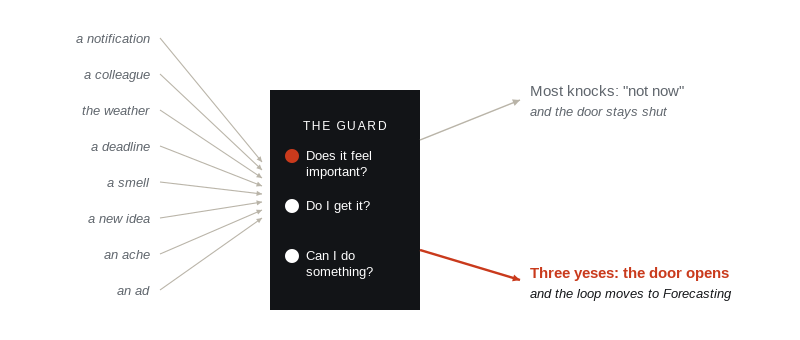
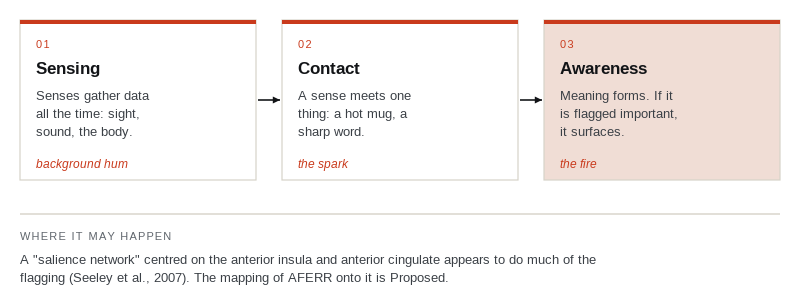
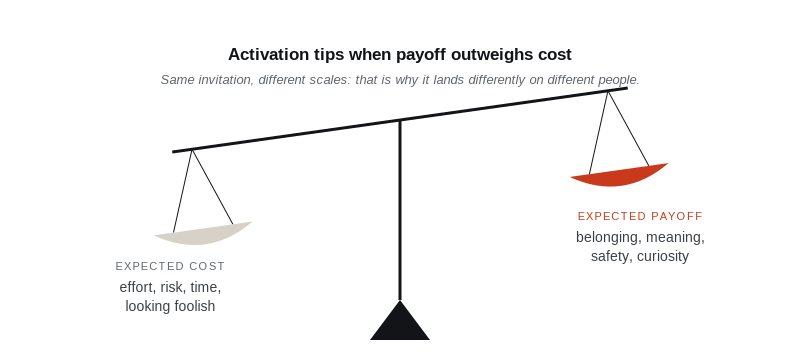
Your brain ignores most of what reaches it. It pays attention when something feels important, makes sense to you, and looks like something you can do something about.
At a glance
- 01Your brain cannot attend to everything, so it keeps asking: is this worth it?
- 02It says yes when something feels important, makes sense, and looks like something you can act on.
- 03Feeling comes first. Curiosity, fear and anticipation speed Activation up; boredom and cynicism slow it down.
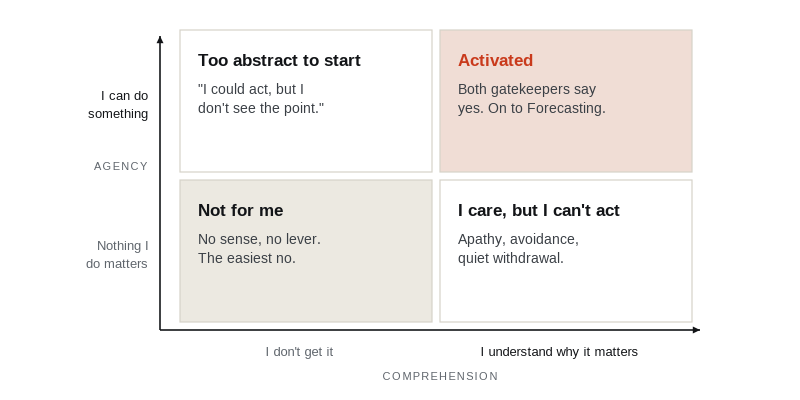
- 04Two gatekeepers decide: comprehension (do I get it?) and perceived agency (can I do anything?).
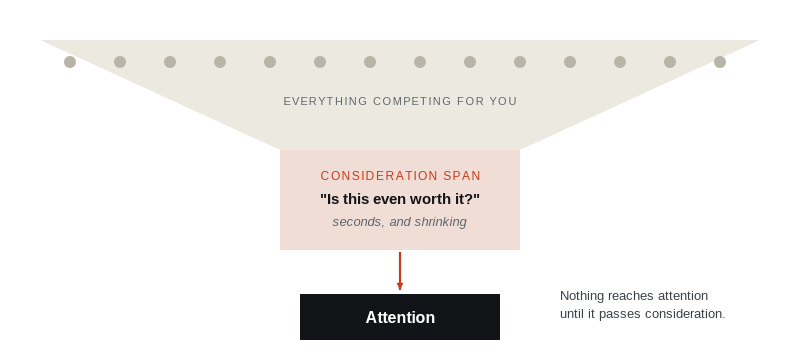
- 05What has shrunk is not attention span but consideration span: the time we give to deciding if something deserves attention at all.
Words to know
Try this today
Catch one thing you ignored today. Ask: did I not understand it, or did I think I could not change it?
An everyday example
You’re working in a busy office. Music plays faintly from two rooms away, and outside, a construction crew is drilling. You stopped hearing either of them an hour ago. Then the song changes to one you love. Suddenly you can follow every word, and the drilling seems to fade. Nothing about the sound has changed. A phone recording would pick up the music and the drilling just as it did a minute ago. What changed is your brain’s decision about what deserves your attention. The song feels good, it’s familiar, and it pulls you in. That decision, made before you’ve had a single clear thought, is Activation.
Activation in 5 figures
Sources
- Bandura, A. (1977). Self-efficacy: Toward a unifying theory of behavioral change. Psychological Review, 84(2), 191-215. https://doi.org/10.1037/0033-295X.84.2.191
- Barrett, L. F. (2017a). How emotions are made: The secret life of the brain. Houghton Mifflin Harcourt.
- Barrett, L. F. (2017b). The theory of constructed emotion: An active inference account of interoception and categorization. Social Cognitive and Affective Neuroscience, 12(1), 1-23.
- Gruber, M. J., Gelman, B. D., & Ranganath, C. (2014). States of curiosity modulate hippocampus-dependent learning via the dopaminergic circuit. Neuron, 84(2), 486-496. https://doi.org/10.1016/j.neuron.2014.08.060
- Kang, M. J., Hsu, M., Krajbich, I. M., Loewenstein, G., McClure, S. M., Wang, J. T., & Camerer, C. F. (2009). The wick in the candle of learning: Epistemic curiosity activates reward circuitry and enhances memory. Psychological Science, 20(8), 963-973. https://doi.org/10.1111/j.1467-9280.2009.02402.x
- Kidd, C., & Hayden, B. Y. (2015). The psychology and neuroscience of curiosity. Neuron, 88(3), 449-460. https://doi.org/10.1016/j.neuron.2015.09.010
- Loewenstein, G. (1994). The psychology of curiosity: A review and reinterpretation. Psychological Bulletin, 116(1), 75-98. https://doi.org/10.1037/0033-2909.116.1.75
- Maier, S. F., & Seligman, M. E. P. (2016). Learned helplessness at fifty: Insights from neuroscience. Psychological Review, 123(4), 349-367. https://doi.org/10.1037/rev0000033
- Menon, V., & Uddin, L. Q. (2010). Saliency, switching, attention and control: A network model of insula function. Brain Structure and Function, 214(5-6), 655-667. https://doi.org/10.1007/s00429-010-0262-0
- Seeley, W. W., Menon, V., Schatzberg, A. F., Keller, J., Glover, G. H., Kenna, H., Reiss, A. L., & Greicius, M. D. (2007). Dissociable intrinsic connectivity networks for salience processing and executive control. Journal of Neuroscience, 27(9), 2349-2356. https://doi.org/10.1523/JNEUROSCI.5587-06.2007
- Simon, H. A. (1971). Designing organizations for an information-rich world. In M. Greenberger (Ed.), Computers, communications, and the public interest (pp. 37-72). Johns Hopkins Press.
AFERRism · Monthly
Learn how you learn.
One email a month about how people learn from experience. Each issue has one piece of research, one move in practice, and one question to think about.
The AFERR course · 10 lessons