02 / 05 · Guess
Forecasting
“What happens if…?”
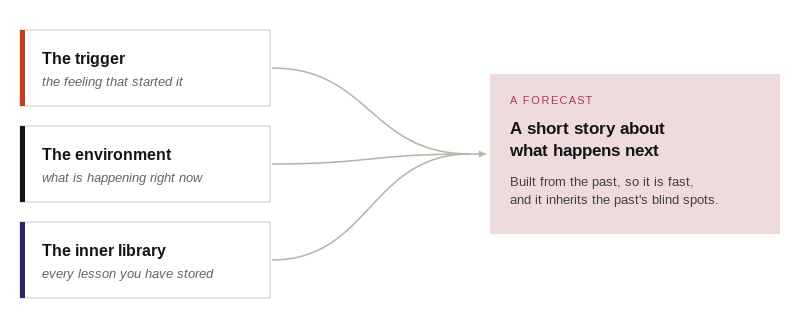
Before you act, you predict what will happen. The prediction is built from what’s in front of you and from what happened last time.
At a glance
- 01Before you act, your brain writes a short story about what will happen next.
- 02It builds that story from three ingredients: the trigger, the moment and your memory.
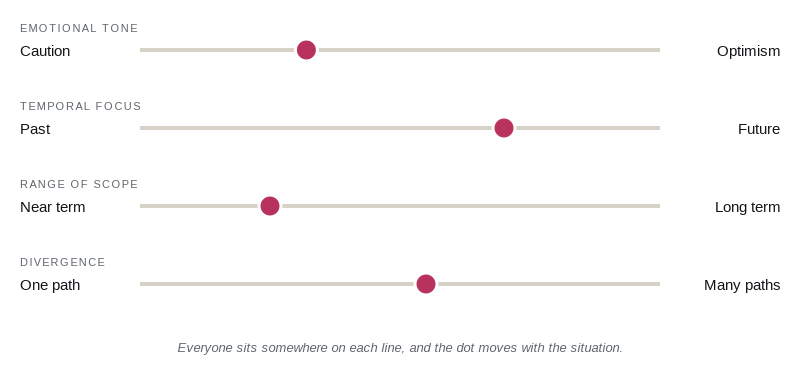
- 03Forecasts lean in four ways: caution or optimism, past or future, near or long term, one path or many.
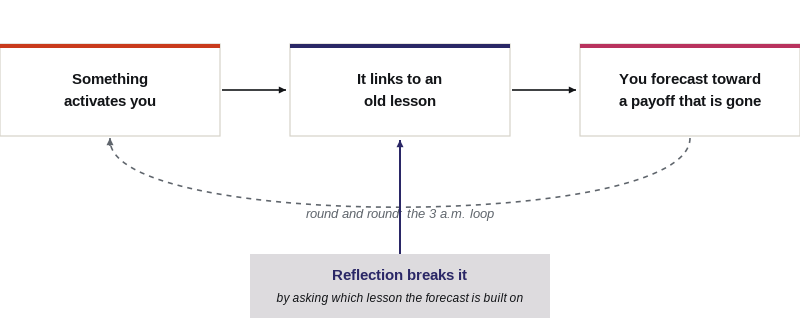
- 04A forecast built on an outdated lesson keeps you circling. That is the 3 a.m. loop.
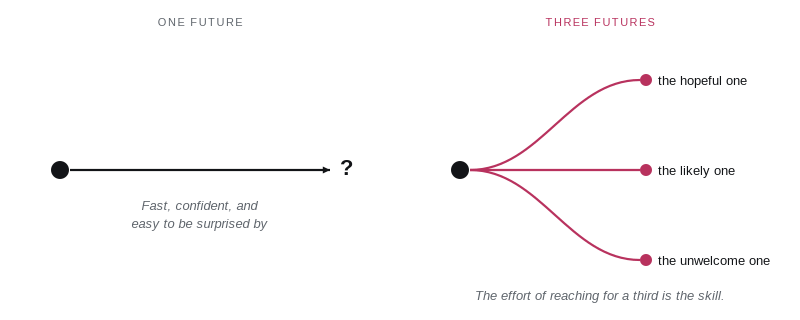
- 05The simplest upgrade: write three possible outcomes instead of one.
Words to know
Try this today
Before your next meeting, write three ways it could go: hopeful, likely, unwelcome.
An everyday example
Your manager sends a message at the end of the day: “Can we talk tomorrow morning?” No subject, no hint. Before you’ve closed your laptop, you’ve already decided what it means. You missed something in the report. Someone complained. Maybe the team is changing, and your job with it. You lie awake rehearsing answers to a conversation that hasn’t happened. None of it is fact yet. Your brain is doing what it always does before you act: predicting what comes next, from this moment and from what happened last time. This one leans cautious. Predicting like this is Forecasting, and it shapes how you walk in tomorrow.
Forecasting in 4 figures
Sources
- Buehler, R., Griffin, D., & Ross, M. (1994). Exploring the “planning fallacy”: Why people underestimate their task completion times. Journal of Personality and Social Psychology, 67(3), 366-381. https://doi.org/10.1037/0022-3514.67.3.366
- Clark, A. (2013). Whatever next? Predictive brains, situated agents, and the future of cognitive science. Behavioral and Brain Sciences, 36(3), 181-204.
- Friston, K. (2010). The free-energy principle: A unified brain theory? Nature Reviews Neuroscience, 11(2), 127-138. https://doi.org/10.1038/nrn2787
- Gilbert, D. T., & Wilson, T. D. (2007). Prospection: Experiencing the future. Science, 317(5843), 1351-1354. https://doi.org/10.1126/science.1144161
- Kahneman, D., & Tversky, A. (1979). Prospect theory: An analysis of decision under risk. Econometrica, 47(2), 263-291. https://doi.org/10.2307/1914185
- Keller, G. B., & Mrsic-Flogel, T. D. (2018). Predictive processing: A canonical cortical computation. Neuron, 100(2), 424-435. https://doi.org/10.1016/j.neuron.2018.10.003
- Klein, G. (2007). Performing a project premortem. Harvard Business Review, 85(9), 18-19.
- Schacter, D. L., & Addis, D. R. (2007). The cognitive neuroscience of constructive memory: Remembering the past and imagining the future. Philosophical Transactions of the Royal Society B, 362(1481), 773-786. https://doi.org/10.1098/rstb.2007.2087
- Seligman, M. E. P., Railton, P., Baumeister, R. F., & Sripada, C. (2013). Navigating into the future or driven by the past. Perspectives on Psychological Science, 8(2), 119-141. https://doi.org/10.1177/1745691612474317
- Tetlock, P. E., & Gardner, D. (2015). Superforecasting: The art and science of prediction. Crown.
- Watkins, E. R. (2008). Constructive and unconstructive repetitive thought. Psychological Bulletin, 134(2), 163-206. https://doi.org/10.1037/0033-2909.134.2.163
AFERRism · Monthly
Learn how you learn.
One email a month about how people learn from experience. Each issue has one piece of research, one move in practice, and one question to think about.
The AFERR course · 10 lessons