00The idea in one breath
Once something matters to you, your brain starts guessing what will happen next. It mixes how you feel, what is going on around you, and what you learned before. Those guesses decide what you do. Good guessers don’t guess right every time. They imagine more than one future, and they notice when an old lesson no longer fits. That is Forecasting.
How to read this paper
This paper runs the loop it describes: Notice, Guess, Try, See, Keep. Each part opens with a short version simple enough for a child, then a longer version for anyone who wants depth.
01 · NoticeNotice
That is Forecasting. Nobody asked you to do it. Your brain did it because tomorrow mattered.
Going deeper
Forecasting is what happens when we feel something strongly enough that we cannot help thinking about it. Activation, the first move of AFERR, decides that something matters. Forecasting asks the obvious next question:
Now that this matters, what happens next, and what should I do?
It is the second beat in the rhythm of learning. It is where a feeling becomes a plan, or a worry, or a hope. And because it happens before we act, it quietly decides which actions we will even consider.
02 · GuessGuess
Hold on to your answer. Part 4 will give you a way to check it.
Going deeper
That question asked you to forecast your own forecasting. Most people answer “I chose badly.” In AFERR sessions we more often see the second pattern: a single imagined future, held with confidence, with no plan for the others. (Observed in facilitated simulations; not yet tested.)
03 · TryTry
Going deeper
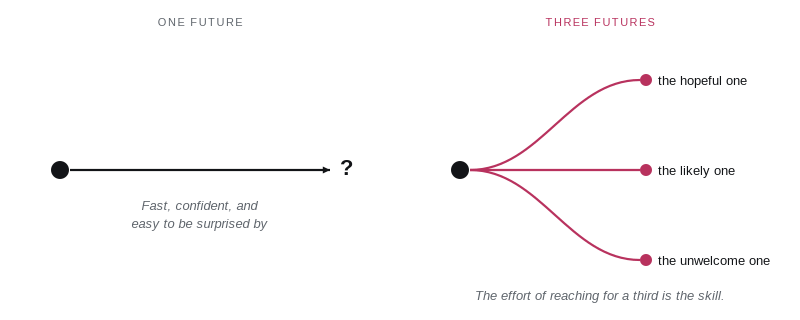
If the first one came easily and the third was hard, notice that. Most of us carry one vivid forecast and a couple of vague alternatives. The effort you felt reaching for a third is the effort of widening a forecast, and it is a skill. Gary Klein’s premortem uses a version of this: before a project starts, the team imagines it has already failed and works out why (Klein, 2007). Giving people permission to imagine the unwelcome future surfaces risks a hopeful plan would hide.
A second exercise, for the brave: notice the next time a worry loops in your head. Ask, which past experience is this forecast built on? You may find it is built on something that is no longer true.
04 · SeeSee
Now look back at the decision you thought of in Part 2. How many futures did you imagine at the time? If it was one, the problem may not have been the choice. It may have been the forecast.
4.1 Why we forecast
Over the last two decades, a large body of work has described the brain as a prediction engine. It does not wait passively for the world to arrive. It constantly predicts what will come next and updates when it is wrong (Friston, 2010; Clark, 2013; Keller & Mrsic-Flogel, 2018). Psychologists have made a related case: that humans are better understood as navigating towards imagined futures than as driven by the past (Seligman, Railton, Baumeister & Sripada, 2013). Evidence: predictive processing is a leading but still debated account; AFERR’s use of it is Proposed.
AFERR adds one emphasis. We do not forecast for its own sake. We forecast to secure a payoff: success, safety, belonging, meaning, or simply peace. Forecasting is how the brain decides where to spend time, energy and belief, and those choices are rooted in the feeling that started the loop. You don’t think hard about things you don’t care about.
4.2 How a forecast is built
A forecast is a short story the brain writes from three ingredients.
- The trigger. The feeling from Activation that started the loop.
- The environment. What is happening right now, as the senses report it.
- The inner library. Lessons from past experience: every earlier realization we have stored.
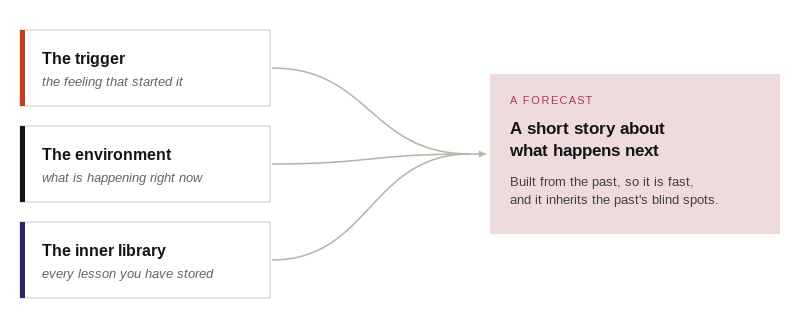
Memory research shows why the third ingredient matters so much. The systems we use to remember the past are largely the same ones we use to imagine the future. We build futures by recombining pieces of what we have already lived (Schacter & Addis, 2007; Gilbert & Wilson, 2007). This makes forecasting powerful and fast. It also means that our futures are made of our past, and inherit its blind spots.
Sometimes the whole process takes milliseconds. Sometimes it keeps us awake at 3 a.m., going round in circles. AFERR describes that circling as an incomplete loop: a forecast that never reaches Experimentation or Realization, so it never gets corrected. Research on repetitive thought draws a similar line between productive, concrete planning and unproductive, abstract rumination (Watkins, 2008).
4.3 The four forecasting affinities
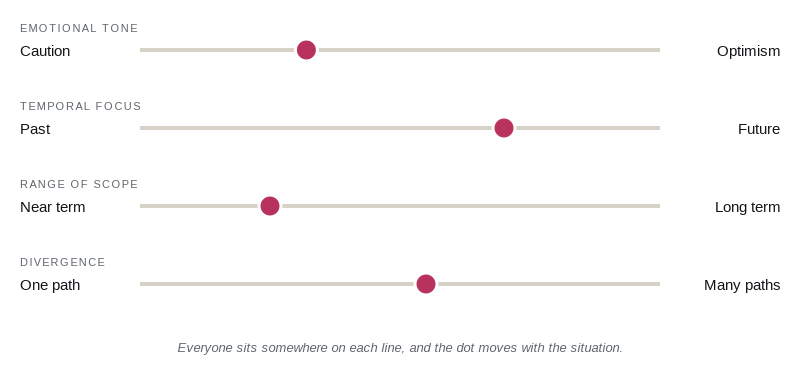
Across facilitated simulations, AFERR practitioners have observed forecasts leaning along four spectrums. We call them affinities. Everyone sits somewhere on each, and the position shifts with context. (Observed; not yet validated as a measure.)
| Affinity | Spectrum | The question it answers |
|---|---|---|
| Emotional tone | Caution ⇄ Optimism | Do I see threat or opportunity? |
| Temporal focus | Past ⇄ Future | Am I forecasting from memory or from vision? |
| Range of scope | Near term ⇄ Long term | Am I solving for now, or for later? |
| Divergence of options | One path ⇄ Many paths | How many futures am I willing to consider? |
None of the poles is “right”. Caution saves lives in a crisis. Optimism starts companies. A past focus protects against repeating mistakes. A future focus spots what is coming. The risk is being stuck at one pole when the situation needs the other. Decades of research on judgement show how predictably our forecasts lean: we weigh losses more heavily than equal gains (Kahneman & Tversky, 1979), and we routinely underestimate how long our own plans will take (Buehler, Griffin & Ross, 1994).
4.4 When forecasting fails: forecasting from yesterday’s truth
A familiar experience: a scenario plays over and over in your head. It doesn’t help. It doesn’t feel good. You can’t stop. AFERR offers an explanation.
- Something activates you.
- The activation connects to an old realization, a lesson learned long ago.
- The brain maps today’s feeling onto yesterday’s truth, and forecasts towards a payoff that is no longer real, or was never yours to begin with.
Running an outdated realization is like installing a new app on an old operating system.
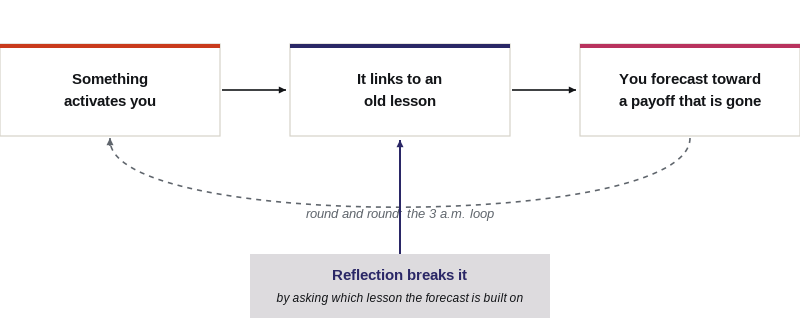
This is where Reflection, the fifth move, reaches back into Forecasting. Reflection is how we notice which lessons our forecasts are built on, and update them.
4.5 Forecasting together
Groups forecast too, and in groups it becomes culture.
- In individuals, forecasting shapes how we set goals, judge risk and relate to time.
- In teams, forecasting creates shared understanding or quiet dissonance. When people don’t forecast together, they act on different futures and trust erodes. When they do, alignment emerges.
- In organisations, forecasting lives in strategy, planning and policy. Narrow forecasting makes an organisation fragile. Broad forecasting makes it resilient.
Research on expert prediction supports the value of the broad posture: forecasters who consider many perspectives, update often and think in probabilities tend to outperform confident single-view experts (Tetlock & Gardner, 2015).
4.6 What we see in simulations
In Evivve sessions, the patterns repeat. (Observed.)
- A player who sees only their own outcome forecasts narrowly.
- A player who imagines ripple effects across the whole system forecasts with range.
- A team that plans only for Plan A is fragile when Plan A breaks.
- A team with contingencies and a shared picture of the future recovers faster.
Players lose rounds because they forecast poorly. Some later report winning real decisions because they learned to forecast better. That transfer is the point.
05 · KeepKeep
5.1 How to tell if forecasting is healthy
| Dimension | What to listen for |
|---|---|
| Caution ⇄ Optimism | The language of threat, or the language of possibility. |
| Past ⇄ Future | References to what happened before, or to what might emerge. |
| Near ⇄ Long term | Focus on the immediate win, or on later consequences. |
| Volume | How many options are imagined before acting. |
The fastest check: ask a person or a team, “What are three ways this could play out?” If they can only give one, they are forecasting reactively, not reflectively.
5.2 For people who design learning
- Build in non-linear paths. When there is more than one route to success, learners widen their forecasts. A single right answer narrows them.
- Make forecasts visible. Ask learners to write down what they expect before they act, so the gap is undeniable afterwards.
- Ask for the third option. Two options become a debate. Three become a decision.
5.3 For leaders
Many failed launches start as forecast failures. (Observed.) In planning conversations, notice which affinity the room is stuck in. If everyone is optimistic, ask for the premortem. If everyone is cautious, ask what happens if it works. If everyone is solving for this quarter, ask about next year.
5.4 Limits and open questions
- The four affinities come from practitioner observation. They need testing: do they hold as distinct dimensions, and do they predict outcomes?
- Predictive processing is a strong but contested framework. AFERR uses it as a guide, not as proof.
- The “incomplete loop” account of rumination is a proposal. It is consistent with research on repetitive thought but has not been tested directly.
5.5 What comes next
A forecast is only a story until it meets the world. The next move is Experimentation, the subject of Phase Paper 03.
Forecasting is not prediction. It is preparation. The mind that learns to forecast well becomes its own guide.