00The idea in one breath
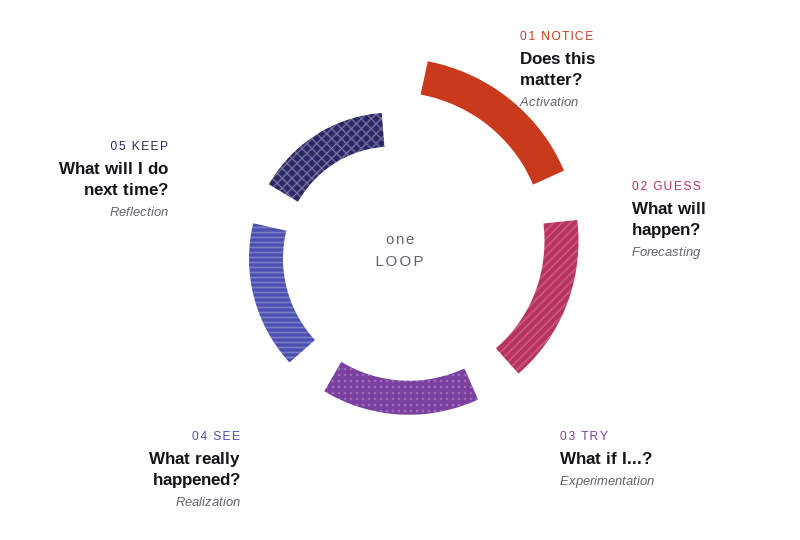
When something matters to you, you notice it. You guess what will happen. You try something. You see what really happened. Then you keep the lesson, so next time goes better. That is the whole loop. We call them Activation, Forecasting, Experimentation, Realization and Reflection. Together: AFERR.
How to read this
This piece runs the loop it describes. It has five short parts: Notice, Guess, Try, See, Keep. Each part opens with a simple version, the kind you could read to a child. Then comes a deeper version for anyone who wants more. Read only the simple versions and you will understand AFERR. Read everything and you will be able to use it.
01 · NoticeNotice
Right now your eyes, ears and skin are taking in far more than you could ever think about. The pressure of the chair. The hum of a fan. The colour of the wall. Almost all of it slides past. A few things get through. Those few things are where every bit of learning starts.
Going deeper
The brain cannot afford to think about everything, so it decides, very quickly, what is worth the cost. In AFERR this first move is called Activation. It answers one question: is this worth my time, energy and self?
Two quiet gatekeepers make that call. The first is comprehension: do I understand this well enough to see why it matters? The second is agency: can I actually do anything about it? When both say yes, attention follows. When either says no, we look away, however important the thing might be. That is why people ignore problems they cannot understand, and problems they feel powerless to change.
The deciding signal often starts as a feeling. Curiosity, worry, excitement, irritation. Each one is the brain saying this matters.
02 · GuessGuess
You just did the second move. The moment something matters, the mind starts imagining what might happen next. Nobody has to tell it to.
Going deeper
This move is Forecasting. The brain builds a small story about the future from three ingredients: the feeling that started it, what is happening right now, and everything it has learned before. Then it runs the story forward. If I say this, she will be angry. If we launch now, we will beat them. If I touch the stove, it will burn.
Forecasts are not neutral. Some lean cautious, some optimistic. Some look back at what happened last time, some look forward at what could be. Some see only the next hour, some see the next year. Some imagine one path, some imagine many. The shape of your forecast decides the options you can even see. And a forecast built on an old lesson can keep you circling the same worry at three in the morning, running yesterday’s answer on today’s problem.
Your guess about the two people in the room was a forecast. Notice how fast you made it.
03 · TryTry
That is the third move. A guess stays a guess until you test it.
Going deeper
This move is Experimentation. It is where a forecast meets the world. The brain learns from the gap between what it expected and what it got (Schultz et al., 1997), and you only get that gap by acting. Reading about swimming does not teach you to swim.
How people experiment says a lot about where they are. Some wait until they are certain (passive). Some only act when pushed (reactive). Some try everything to see what happens (explorative). Some try with purpose, with others, and adjust as they go (participative). None of these is a personality type. They are places people stand in a given moment, and they move.
The single biggest condition for good experimentation is safety. People try more, and more honestly, when a mistake costs little. That is why simulations, rehearsals and pilots work: they let people be wrong cheaply, so they can be right later when it counts.
04 · SeeSee
That moment, when you compare what you expected with what is true, is the fourth move.
Going deeper
This move is Realization: connecting what you did to what happened. It sounds automatic. It is not. People win and assume they were skilful. People lose and assume they were unlucky. Both close the loop too early, with a comfortable story instead of an accurate one.
A realization can be a judgment or a vision. A judgment closes things down: I’m not good at this. They always let me down. A vision opens them up: I rushed because I was afraid of being wrong. Both feel like insight. Only one leads anywhere. The emotional state you are in at the moment you make sense of something shapes which kind you form.
This is also where most organisations lose their learning. (Observed.) They run the project, ship the product, finish the quarter, and move straight on. The data was there. Nobody stopped long enough to see it.
05 · KeepKeep
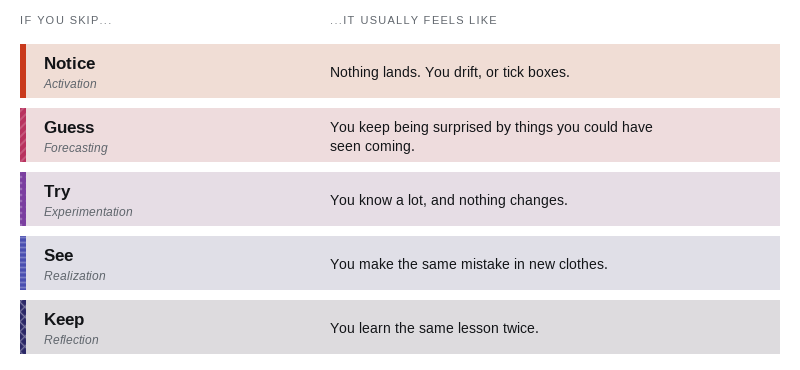
That is the fifth move. In our sessions, it’s the move people skip most often.
Going deeper
This move is Reflection. It is where an experience becomes part of how you see the world, so the next loop starts from a better place. Reflection is not the same as thinking about the past. It is choosing what the past will mean for the future. It needs three things the modern day rarely offers: a pause, some distance from the moment, and an honest question.
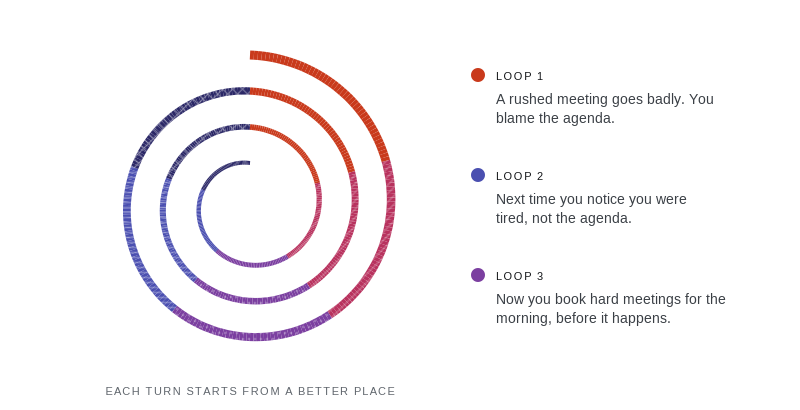
Here is why the AFERR mark is drawn as a loop that never quite closes. Each time you reflect well, you change what you will notice next time. Your next Activation is sharper. Your next Forecast is wiser. Each time round, the loop goes one step deeper.
Why it matters
The faster the world changes, the more it pays to know how you change. Most people are never taught how they learn. They are taught what to learn. AFERR is an attempt to name the moves, so that individuals, teams, teachers and leaders can see which one they rushed, which one they skipped, and which one to practise next.
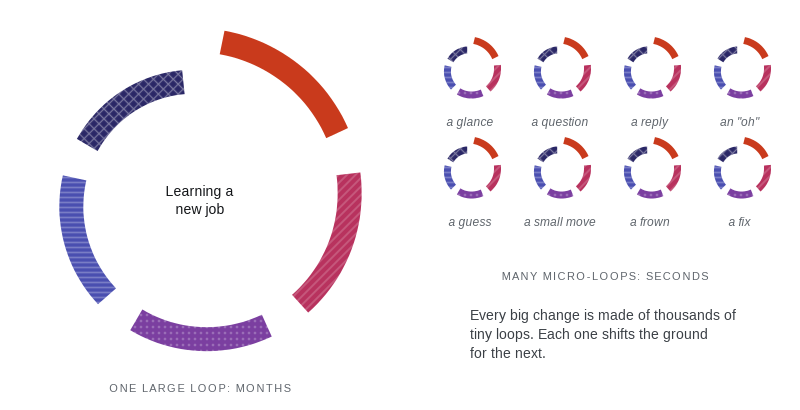
It is a map, not the territory. The brain loops, branches and doubles back. Thousands of tiny AFERR loops can run inside a single big one: a glance, a guess, a small move, a flicker of oh, a slight change in how you will look next time. The five names simply make those loops visible.
Where to go next
Each move has its own paper. Read them in any order. Each one is written the same way: a story to notice, a question to guess at, something small to try, the model laid out to see, and questions to keep.
- Phase Paper 01 · Activation: how the brain decides what is worth its attention.
- Phase Paper 02 · Forecasting: how we build the futures we act on.
- Phase Paper 03 · Experimentation: why we learn by testing, and how to make testing safe.
- Phase Paper 04 · Realization: how we connect what we did to what happened, and how we get it wrong.
- Phase Paper 05 · Reflection: how experience becomes the person you are next.
A note on evidence
AFERR is a framework, not a proven law of the brain. Each phase is linked to well-studied processes in cognitive science (attention and salience, prediction, learning from error, feedback, metacognition), and each paper cites that work. The model itself was built from years of watching people in facilitated simulations, chiefly Evivve. We label every claim with how sure we are: Proposed (reasoned from theory and the literature), Observed (seen repeatedly in practice, not controlled), Tested (studied with a stated method) or Reviewed (peer reviewed). This primer is Proposed.