00The idea in one breath
After you try something, something happens. Realization is when you work out why. It sounds easy, but people often grab the first explanation that feels good, especially when they win. A good realization is honest, open and specific: not “I’m bad at this”, but “I rushed because I was scared of looking wrong.” That is Realization.
How to read this paper
This paper runs the loop it describes: Notice, Guess, Try, See, Keep. Each part opens with a short version simple enough for a child, then a longer version for anyone who wants depth.
01 · NoticeNotice
That moment, when each child decided what the fall meant, is Realization.
Going deeper
Realization is the most human moment in the AFERR loop. It is where feeling, experience and thought meet, and what we did becomes what we learned. It is a threshold: the first time a person sees themselves in the mirror of their own choices.
Forecasting happens in the mind. Experimentation happens in behaviour. Realization happens in time: it is about how quickly, and how accurately, we assign meaning to what we did and what followed. AFERR proposes that the speed of accurate realizations, not the speed of action, is the truest benchmark of a person’s ability to learn.
02 · GuessGuess
Going deeper
Most people say losing. The answer from practice is more interesting: people can learn a great deal from both, but they are far less likely to try to learn from a win. In simulation debriefs, teams that win often feel there is nothing left to examine. (Observed.) In a study of soldiers on navigation training, those debriefed on their successes as well as their failures improved more than those who reviewed failures alone (Ellis & Davidi, 2005).
03 · TryTry
Going deeper
Notice which version you believed first. Most of us explain our successes by our own qualities and our failures by circumstances. Psychologists call this the self-serving bias, and have argued since the 1970s about how strong it is and where it comes from (Miller & Ross, 1975). When we are explaining other people’s behaviour, we do the reverse: we overweight their character and underweight their situation (Ross, 1977). Writing three explanations instead of one is a small way of keeping the loop open long enough to see what was really going on.
04 · SeeSee
4.1 Closing the prediction gap
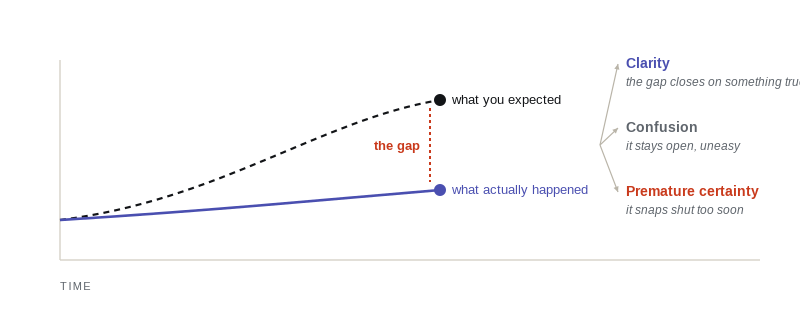
Every loop begins with a forecast: if I do this, that will happen. Life rarely obliges. When the outcome doesn’t match the forecast, the brain registers a prediction error, a gap. Dopamine signalling has been closely linked to exactly this kind of gap between expected and actual outcomes (Schultz, Dayan & Montague, 1997). The gap is uncomfortable. It makes us alert, and it pushes us to explain.
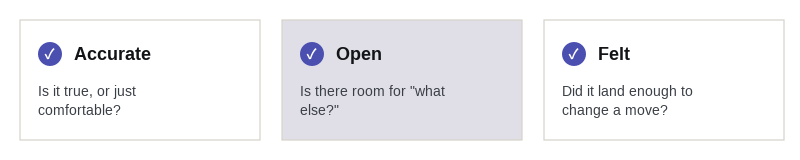
Realization is the moment that gap closes. It can close with clarity, with confusion, or with premature certainty. The question is never whether a realization happens. It is whether the realization is accurate, open and felt enough to change behaviour.
4.2 The “aha” moment
Insight has a recognisable signature. In a well-known study, solving word puzzles with a sudden flash of insight, compared with working them out step by step, was associated with a burst of activity in the right anterior superior temporal gyrus (Jung-Beeman et al., 2004; see Kounios & Beeman, 2014). The point for practice is not the brain region. It is that insight feels different from deduction, and that the feeling of certainty arrives whether or not the insight is correct (Danek & Wiley, 2017; Laukkonen et al., 2020).
4.3 Judgment and vision
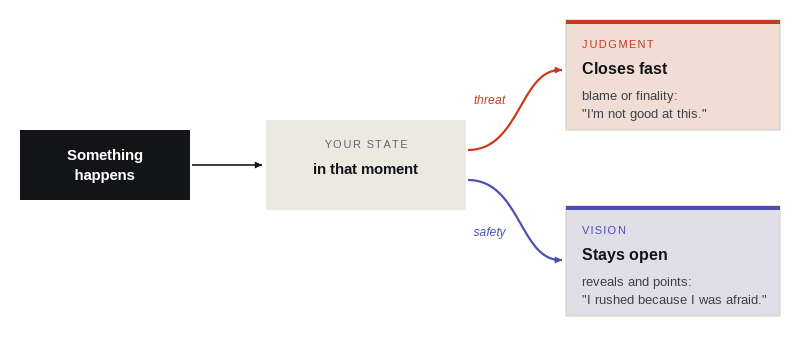
One of the clearest patterns in AFERR practice is that a realization can take one of two shapes. (Observed.)
- Judgment-based realizations tend to appear when the loop began in fear, ego or insecurity. They close quickly, with blame or finality. “I’m not good at this.” “They always let me down.” “We should have played it safe.”
- Vision-based realizations tend to appear when the learner stays open and curious. They reveal something, build compassion, and point somewhere. “I rushed that decision because I was afraid of being wrong.” “I didn’t ask for help, and now I can see why that mattered.”
The emotional state at the moment of sense-making shapes which one forms. Strong emotion narrows the range of information we take in (Easterbrook, 1959) and strengthens how firmly an experience is stored (McGaugh, 2004). So the same event, made sense of in a moment of threat or a moment of safety, can be remembered as two different lessons. Helping learners name which kind of realization they are forming is one of the most useful things a facilitator can do.
4.4 The trap of triumph: premature closure
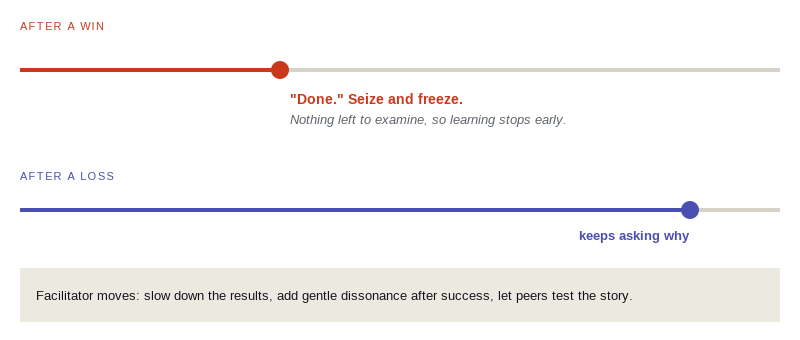
The brain likes closure. As soon as it senses a conclusion, it relaxes, often too early. Research on the need for cognitive closure describes how people under pressure tend to “seize” on an early answer and then “freeze” on it (Kruglanski & Webster, 1996).
In simulations, this happens more after success than after failure. (Observed.)
When the reason you played was to win, and you win, you feel done. There is nothing left to learn.
Winning does not mean learning happened. Often it prevents it. Facilitators can protect learners from the trap of triumph by slowing down the delivery of results, introducing gentle dissonance even after success (“What else could you have done? What would have happened if they hadn’t made that mistake?”), and using peers to test assumptions.
4.5 Realization as identity work
Realization is also personal. This is where a learner stops asking what happened? and starts asking who was I, in what happened?
It is where inner stories shift:
- from “I failed” to “I was afraid of being seen”,
- from “we made a mistake” to “we never agreed what we expected of each other”,
- from “I’m not a leader” to “I avoided discomfort and called it humility”.
Realization exposes the unconscious rules we operate by. That is why it can feel fragile. Mishandled, a realization becomes shame. Ignored, it becomes justification. Respected, it becomes a platform.
4.6 Feedback that lands
Realization depends on feedback, but not all feedback helps. A major review found that in more than a third of cases, feedback interventions actually made performance worse, especially when feedback drew attention to the self rather than the task (Kluger & DeNisi, 1996). Feedback works best when it answers three questions for the learner: where am I going, how am I going, and where to next (Hattie & Timperley, 2007).
In AFERR terms: a score is not a realization. “You scored 82%” closes the loop on a number. “This was your plan. This was the outcome. What do you make of the gap?” keeps it open long enough for meaning to form.
4.7 Realizing together
We rarely realize alone. Organisational researchers describe sensemaking as a social process: people make meaning by talking, comparing and building shared accounts of what happened (Weick, 1995). In simulation debriefs, realizations deepen when others reflect a person’s behaviour back to them with precision and care. (Observed.)
We realize with others too, when they show us who we were in the moment.
05 · KeepKeep
5.1 For people who design learning
- Build a story arc. Let learners meet rising tension, real dilemmas and consequences. Realization needs something to make sense of.
- Delay resolution. Don’t hand over scores and outcomes immediately. A little uncertainty keeps curiosity alive.
- Layer the feedback. Show the plan, show the outcome, and ask the learner to explain the gap before you do.
- Use peer witnessing. Ask others to describe, without judgment, what they saw someone do.
5.2 For facilitators and coaches
- Hold a non-judgmental space, and say so.
- Ask open questions. Use mirror language: “I noticed you paused before speaking. What was happening for you there?”
- Resist fixing or moralising. Let the learner own the story.
- Watch for silent realizations: a change in breath, posture or tone often comes before words. Leave room for it.
5.3 For leaders
After a good quarter, run a review as carefully as you would after a bad one. Ask what you would have done if the market had not helped. The organisations that learn fastest are the ones that refuse to let a win close the loop.
5.4 How Realization can be observed
Realization isn’t a score. It is a shift. But it leaves footprints. (Observation prompts, not a validated instrument.)
| Signal | What it may suggest |
|---|---|
| A spoken “aha”, or a sudden summary | The pieces are coming together. |
| An emotional turn after frustration | Feeling is settling into meaning. |
| Changed behaviour in the next round | The insight is being applied. |
| Requests for data or a replay | A wish to see the pattern clearly. |
| Deeper, more specific questions | Curiosity driven by an honest gap. |
| Shift from blame to specifics | A judgment is becoming a vision. |
In Evivve, practitioners look not only at what learners did, but at the stories they tell about what they did. That is where most of the learning is visible.
5.5 Questions to keep
- What is a conclusion you reached quickly last year that you would now explain differently?
- When did you last examine a success as hard as a failure?
- Who in your life shows you who you were in the moment, and do you let them?
5.6 Limits and open questions
- The judgment-versus-vision distinction comes from practice. It needs a coding scheme and testing: can independent observers tell the two apart reliably, and does the difference predict later behaviour?
- “Speed of accurate realization” is a proposed benchmark. Measuring it requires agreement on what counts as accurate, which is not simple in social settings.
- The link between emotional state and the kind of realization formed is consistent with research on emotion and memory, but has not been tested directly in AFERR settings.
5.7 What comes next
Realization is the insight. Reflection is the digestion. A realization still has to be tested, seen again in a new light, joined to memory, and carried forward on purpose. That is the final move, Reflection, the subject of Phase Paper 05. And what we realize today becomes tomorrow’s Activation.
Realization is the beginning of ownership. And ownership is the root of change.