00The idea in one breath
After something happens, and after you work out why, there is one more step: deciding what it means for next time. That is Reflection. It needs a pause, a little distance, and an honest question. Do it, and the next time you start, you start from a better place. Skip it, and you only had an experience.
How to read this paper
This paper runs the loop it describes: Notice, Guess, Try, See, Keep. Each part opens with a short version simple enough for a child, then a longer version for anyone who wants depth.
01 · NoticeNotice
That is Reflection. Nothing new happened. Something old was turned into something for tomorrow.
Going deeper
Reflection is the last named move of AFERR and the most quietly powerful. Activation starts the loop, Forecasting plans, Experimentation tests and Realization reveals. Reflection digests, connects and reorients. It turns raw experience into judgment, and insight into direction.
It is both a process in its own right, with its own work to do, and a force that improves every other move when it is practised on purpose. It is not daydreaming and it is not dwelling. It is active engagement with lived experience that shows what we truly value, where we fall back on habit, and what we are ready to become.
02 · GuessGuess
Going deeper
Most people guess the group that keeps practising, because practice feels productive and reflection feels like a pause. In a field experiment with trainees at a large business process outsourcing company in India, the group that spent time at the end of each day reflecting on what they had learned performed better on a later test than a group that spent the same time on extra practice (Di Stefano, Gino, Pisano & Staats, 2014). Reflection is not time away from learning. It is where learning is consolidated.
03 · TryTry
Going deeper
Notice the difference between the second and third answers. The second is a realization: how you made sense of it in the moment. The third is reflection: choosing what that meaning will do in the future. If the third was hard to write, that is normal. Most of us are well practised at the first two moves of hindsight and barely practised at the third.
A deeper version: write about the same event in the third person, using your own name. “Priya felt dismissed when…” Research on self-distancing suggests that stepping back from the “I” in this way helps people reflect on difficult experiences with more wisdom and less distress (Kross & Ayduk, 2017).
04 · SeeSee
4.1 What Reflection is
Reflection is the deliberate process of reviewing, evaluating and reinterpreting experience, emotion and behaviour, in order to generate insight and act with intention. It has four qualities.
- Pause: slowing the automatic response.
- Distance: stepping far enough back to see the shape of what happened.
- Depth: asking what it means and what follows from it.
- Integration: weaving the insight into how we will act next.
Its questions are simple and hard: What is this moment trying to teach me? What part of myself am I seeing more clearly now? It draws on metacognition, thinking about our own thinking (Flavell, 1979), on emotional regulation, and on the stories we tell about ourselves. The idea is old. John Dewey argued almost a century ago that experience turns into learning through reflective thought, the careful turning over of what happened (Dewey, 1933).
4.2 Reflection in the brain
When we turn inward, to remember, to imagine, to think about ourselves and others, a set of brain regions known as the default mode network becomes more active. It was first noticed because it was more active at rest than during outward-focused tasks (Raichle et al., 2001). It includes regions of the medial prefrontal cortex, linked to judging personal relevance, the posterior cingulate cortex, and connections with the hippocampus, central to memory. It is now understood to support self-generated thought, autobiographical memory and imagining the future (Andrews-Hanna, Smallwood & Spreng, 2014). Evidence: well established; AFERR’s description of Reflection as using this network on purpose is Proposed.
Two practical points follow. First, rest is not idleness. Researchers have argued that constant outward attention may starve the inward processing that learning and identity depend on (Immordino-Yang, Christodoulou & Singh, 2012). Second, time matters. Memory continues to be consolidated after the experience, including during sleep (Diekelmann & Born, 2010). Some reflection happens in minutes. Some takes weeks, months or years.
4.3 Reflection as a skill that matures
Reflection usually begins as a reaction: something surprising happens and we look back at it. With practice it moves earlier, from hindsight towards foresight. AFERR describes four levels. (Proposed, from practice.)
| Level | When reflection happens | What it sounds like |
|---|---|---|
| Hindsight | After an unexpected outcome or realization. | “Why did that go wrong?” |
| In the moment | During action or decision-making. | “Hang on, am I doing it again?” |
| Foresight | Before action, shaping intent and attention. | “Given what I know about myself, how do I want to go into this?” |
| Habit | Built into how a person sees and acts. | Rarely said aloud. Visible in steadiness. |
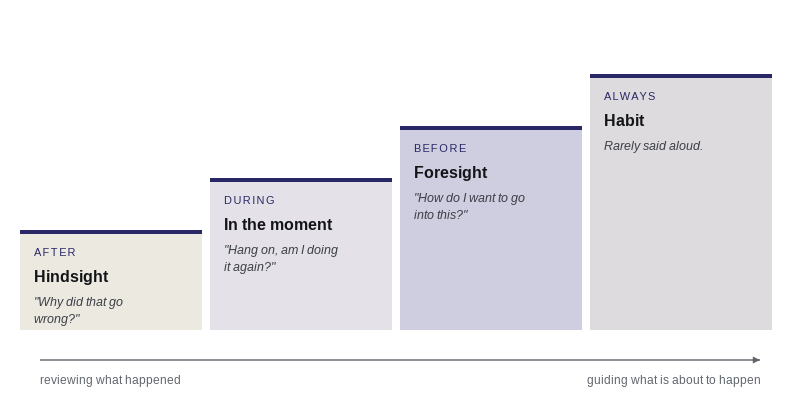
Donald Schön drew a similar line between reflection on action, looking back, and reflection in action, adjusting while you work (Schön, 1983). The AFERR levels add a further step, reflection before action, and a destination where it becomes a way of seeing.
Reflection starts with reviewing what happened. It matures into guiding what is about to happen.
4.4 Reflection inside every move
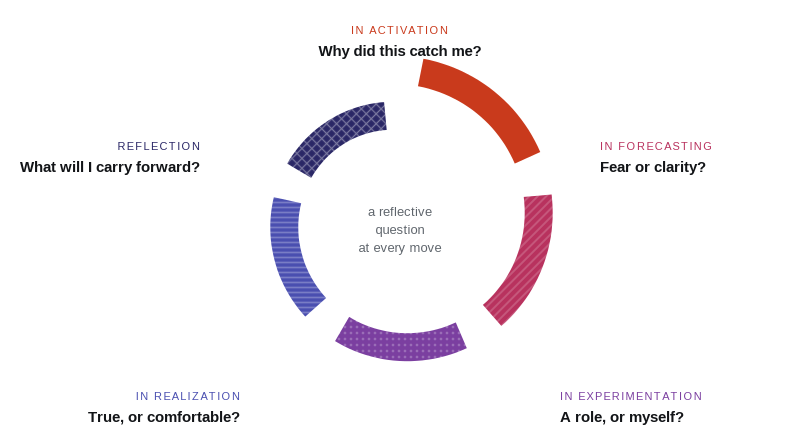
Reflection is the fifth move, but its real power appears when it runs through the other four.
- In Activation: Why did this catch my attention? What old story got switched on?
- In Forecasting: Am I forecasting from fear or from clarity? Which past lesson is this plan built on?
- In Experimentation: Am I playing a role, or showing up as myself? What other choices do I have right now?
- In Realization: Is this conclusion true, or just comfortable? What else could this be about?
Each phase stops being a task and becomes a place where awareness can grow.
4.5 Single-loop and double-loop
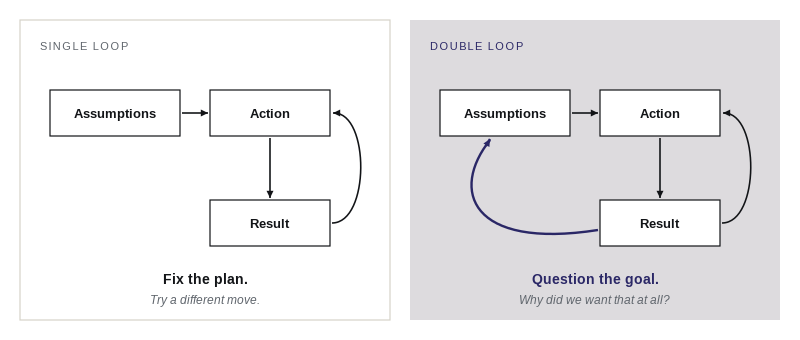
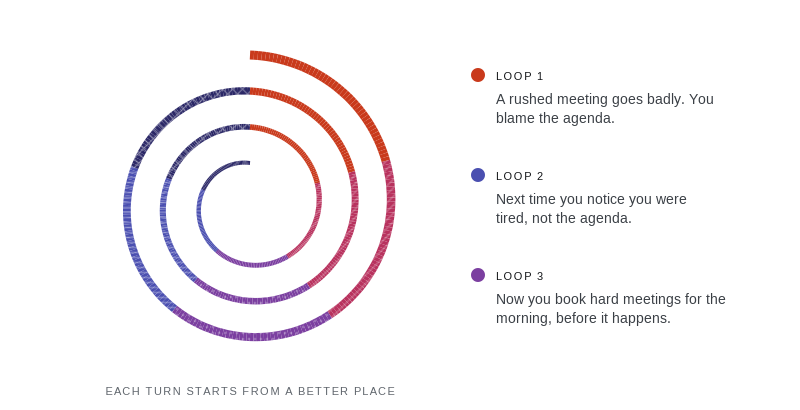
Chris Argyris and Donald Schön distinguished two kinds of learning (Argyris & Schön, 1978). In single-loop learning, we fix the action: the plan failed, so we try a different plan. In double-loop learning, we question the assumptions behind the plan: why did we think that was the goal at all? Reflection is what makes the second loop possible. It is also why the AFERR mark is drawn as a loop that never quite closes. Done well, reflection does not return us to the same starting point. It changes what we will notice next time. The next Activation is sharper. The loop goes one step deeper.
4.6 Old practices, the same insight
Reflection has been treated across many traditions as more than a learning technique: as a discipline.
- In Sufi practice, muraqabah is watchful self-observation.
- In Buddhist practice, vipassana is insight that comes from close attention.
- In Greek philosophy, gnōthi seauton, “know thyself”, was the starting point of a good life.
They arrive at one point: to reflect is to become conscious, and to become conscious is to be able to choose who you are.
05 · KeepKeep
5.1 What Reflection needs
Reflection does best in conditions that are:
- safe: psychologically, emotionally and socially;
- slowed: with space between action and evaluation;
- structured: with prompts, frameworks or facilitated dialogue;
- shared: with peers or mentors who can hold up a mirror.
5.2 Practices that work
- Journaling. Writing about emotional experiences has been linked to benefits for wellbeing and understanding (Pennebaker, 1997). Short and regular beats long and rare.
- Silent pauses after an activity, before anyone speaks.
- Dialogue circles where each person speaks once before anyone responds.
- Self-distancing: writing or speaking about yourself in the third person.
- Micro-questions a facilitator can ask: “What did you feel that you didn’t say?” “What part of this surprised you?” “What do you want to remember about this moment?”
The aim is to support reflection until it runs on its own.
5.3 For leaders and organisations
The quickest way to waste an organisation’s experience is to cut reflection when the workload rises. That is usually when it is needed most. Build it into the rhythm of work: a short review at the end of every project, a question at the end of every meeting (“What did we learn that changes what we do next?”), and a place where lessons are written down and actually read. An organisation that reflects becomes harder to surprise.
5.4 How Reflection can be observed
Reflection can’t be reduced to a score, but its presence can be noticed. (Observation prompts, not a validated instrument.)
| Signal | What it may suggest |
|---|---|
| The story about an event changes | A new perspective is being taken in. |
| Talk turns to what happens next | Insight is being converted into intention. |
| Questions go beyond the outcome | Thinking about thinking is under way. |
| Emotional vocabulary grows | Inner awareness is sharpening. |
| A specific commitment is made and kept | Reflection is reaching behaviour. |
5.5 Questions to keep
- When did you last change your mind about what an old experience meant?
- What is one assumption, not just one action, you would revisit from the past year?
- Where in your week is there a pause long enough for reflection to happen? If there isn’t one, where could you make it?
5.6 Limits and open questions
- The four levels of reflective maturity are proposed from practice and need testing: are they distinct, are they ordered, and can people be helped to move between them?
- AFERR’s use of default mode network research is descriptive. The network supports many kinds of inward thought, not only reflection.
- The claim that reflection improves the other four moves is central to AFERR and is supported by practice. It has not yet been tested in a controlled design.
5.7 What comes next
Nothing ends here. What we reflect on becomes what we notice next time. The loop begins again with Activation, Phase Paper 01, one step deeper than before.
We cannot control every moment. But we can reflect on each one, and in that reflection choose who we become.