00The idea in one breath
You can’t learn to ride a bike by reading about it. You have to get on, wobble, fall a little, and try again. Every time what you expected and what happened don’t match, your brain learns something. Trying is how guesses turn into knowledge. The trick is to make trying safe enough that people are willing to do it. That is Experimentation.
How to read this paper
This paper runs the loop it describes: Notice, Guess, Try, See, Keep. Each part opens with a short version simple enough for a child, then a longer version for anyone who wants depth.
01 · NoticeNotice
Somewhere between that toddler and most adults, something changes. We stop trying things in front of others. We wait to be sure. We ask for the manual.
Going deeper
Experimentation is where a person moves from thought into action: where forecasts meet consequences and the mind’s picture of the world is put to the test. Activation sparks the feeling. Forecasting builds the expectation. Only Experimentation turns those into evidence.
It is not random trial and error, and it is not performing for approval. It is intentional exploration: testing, failing, adjusting, and trying again. To experiment is to give ourselves permission to rehearse who we might become. The outcomes of those rehearsals, success, failure or surprise, become the raw material for the last two moves, Realization and Reflection.
02 · GuessGuess
Going deeper
Most people guess correctly that trying wins. Then they design most of their training as watching. The gap between what we know about learning and how we build it is one of the reasons this paper exists. In a large review of university science courses, students in active-learning classes outperformed those taught by lecture, and were less likely to fail (Freeman et al., 2014).
03 · TryTry
Going deeper
The feeling before is often bigger than the event. That gap, between how risky something felt and how risky it was, is information. It tells you how much of your caution comes from the situation and how much from habit. It is also the gap that well-designed practice spaces are built to close.
A harder version: think of the last time you tried something new at work and it didn’t work. What did you do next? Try again differently, try again the same way, or stop trying? Your answer says something about where you stood in the four dispositions described below.
04 · SeeSee
4.1 Why the brain needs Experimentation
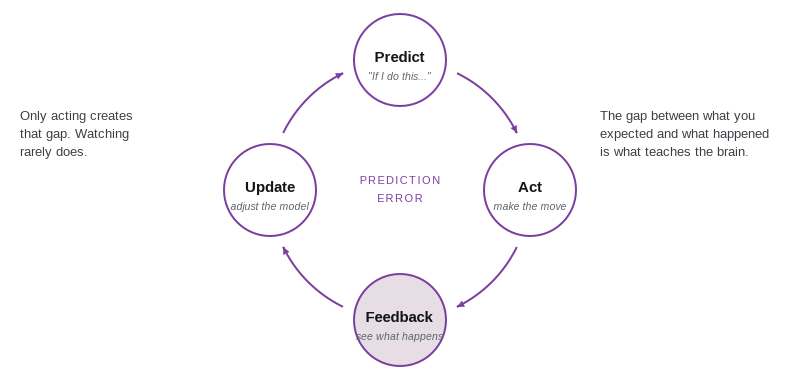
The brain constantly predicts what will happen and updates when it is wrong (Friston, 2010; Clark, 2013). The update is driven by prediction error: the gap between expected and actual. In a landmark series of studies, dopamine neurons were found to fire not simply for rewards, but for rewards that were better or worse than expected, a signal well suited to teaching the brain from surprise (Schultz, Dayan & Montague, 1997). Evidence: well established for reward learning; AFERR’s extension to complex social behaviour is Proposed.
Experimentation is the behavioural form of this loop: predict, act, receive feedback, update. Forecasting lets us imagine outcomes, but only acting generates the mismatches that drive lasting change. Donald Hebb proposed that connections between neurons strengthen when they are active together (Hebb, 1949), later summarised by others as “neurons that fire together wire together”. Experimentation supplies the firing.
Many brain systems are involved: areas of the prefrontal cortex in planning under uncertainty, emotional systems that weigh outcomes, the basal ganglia in learning from repeated feedback, the hippocampus in remembering where and when a strategy worked. The point is not to map each phase to a region.
There is an evolutionary story here too. Organisms that tried new strategies and explored new environments were the ones that adapted. Experimentation is not optional for a learning animal. It is the inheritance.
Processed insight, like processed food, may fill us. It cannot nourish change. Behaviour change needs the friction of uncertainty, the gap between intent and outcome, and the feeling of a real consequence.
This is consistent with long-standing theory. Kolb’s experiential learning cycle places concrete experience at the centre of knowledge building (Kolb, 1984). Bandura showed that confidence in our own ability, self-efficacy, grows most strongly from our own successful attempts (Bandura, 1977). Deliberate practice research shows expertise is built through effortful, feedback-rich trying, not exposure (Ericsson, Krampe & Tesch-Römer, 1993). Studies of productive failure suggest that struggling with a problem before being shown the solution can deepen understanding (Kapur, 2008).
4.2 The four dispositions
Across years of facilitated Evivve simulations, four recurring ways of engaging with uncertainty appear. They are not personality types. They are dispositions: states people move into depending on context, experience and how safe they feel. (Observed.)
| Disposition | What it looks like | Underlying stance | Where the loop is weak |
|---|---|---|---|
| Passive | Withdrawing until certainty or direction appears. | Fear of error, low agency, high need for safety. | Activation and Forecasting. |
| Reactive | Acting only when forced by pressure or a trigger. | Loss aversion, defensiveness, compliance. | Forecasting; Realization is minimal. |
| Explorative | Probing limits, tolerating failure to find what works. | Curiosity, resilience, openness. | Realization; many trials, little synthesis. |
| Participative | Acting with purpose and with others, adjusting as feedback arrives. | Foresight, adaptability, confident agency, collaboration. | Balanced; the risk is plateau without Reflection. |
These form a developmental trajectory, Passive → Reactive → Explorative → Participative, though not a strict ladder. In simulations, many participants begin passively, waiting for cues. Once they see that failure is not fatal, many start exploring. As feedback builds up, some begin to engage participatively. A useful thing to measure is not where someone sits, but how quickly they move.
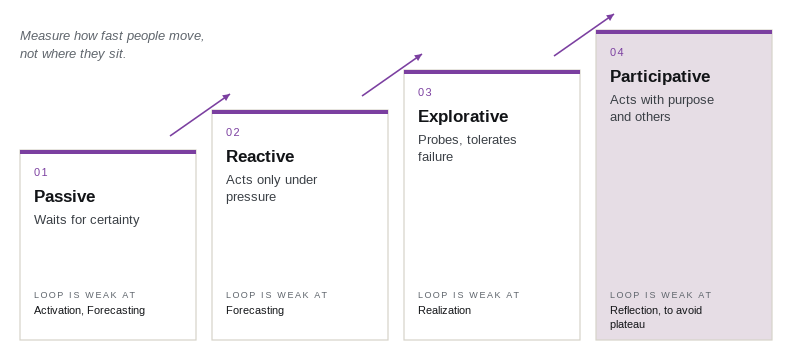
The same person can be passive in one room and explorative in another. That is the most useful thing about dispositions: they point not to who someone is, but to which part of their loop needs support right now.
4.3 Three channels of feedback
Every experiment produces feedback, wanted or not, through three channels.
- External consequences: visible results such as wins, losses, gains and setbacks. Clear, but shallow on their own.
- Social feedback: how others react: support, critique, withdrawal, collaboration. Humans are social learners, so these signals carry heavy emotional weight.
- Internal states: pride, shame, relief, renewed confidence. These last longest and shape identity and future agency. Emotionally charged experiences tend to be remembered more strongly (McGaugh, 2004).
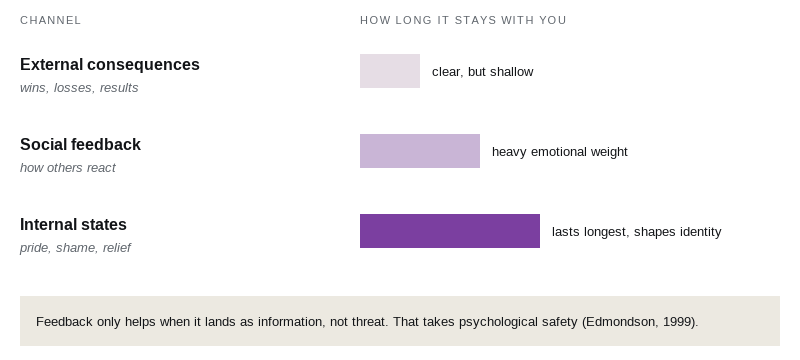
Feedback only helps when it is received as information rather than a threat. That depends on psychological safety: the shared belief that it is safe to take interpersonal risks. Teams with more of it engage in more learning behaviour (Edmondson, 1999). Without safety, feedback triggers defence and learning shuts down. With it, feedback becomes fuel.
4.4 Designing practice spaces
If the real world is too risky to experiment in, build a space where it isn’t. AFERR calls these practice spaces: environments where every move of the loop can run to full depth without catastrophic consequence. A good practice space is not judged by how real it feels, but by whether each move gets what it needs.
- Activation needs meaningful stakes, not trivial exercises.
- Forecasting needs several possible futures, not one right answer.
- Experimentation needs repeated trials with visible but non-destructive consequences.
- Realization needs structured sense-making that people can’t skip.
- Reflection needs explicit time and prompts, so insight carries forward.
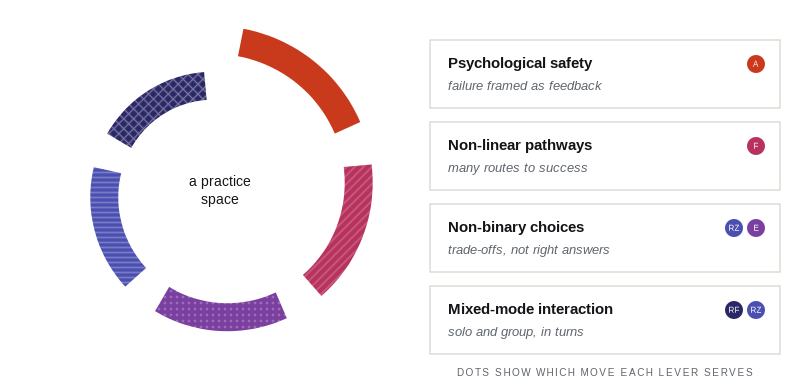
Four design levers make this possible. (Proposed, from practice.)
| Lever | What it does | Phase it serves |
|---|---|---|
| Psychological safety | Frames failure as feedback, so fear gives way to curiosity. | Activation |
| Non-linear pathways | Several routes to success stretch imagination. | Forecasting |
| Non-binary choices | Trade-offs instead of right and wrong answers create real surprises and nuanced conclusions. | Experimentation, Realization |
| Mixed-mode interaction | Shifts between solo and group work let sense-making happen at both levels. | Realization, Reflection |
At every scale the principle is the same. For individuals: safe-to-fail side projects and personal prototypes. For teams: pilot sprints, simulations and debriefs where mistakes are mined, not punished. For organisations: pilots, sandboxes, innovation labs and recognition for intelligent failure.
05 · KeepKeep
5.1 What “better” looks like
Growth in Experimentation rarely shows up as higher first-attempt success. It shows up in the quality of the loop. (Observed.)
- Error half-life shrinks. People recover from mistakes sooner and pivot instead of fixating.
- Co-modulation improves. Energy, agency and foresight rise together, rather than one racing ahead (high energy with no plan, or careful plans with no action).
- Up-cycling appears. Feedback is turned into criteria for the next attempt. The story changes from “we got unlucky” to “our pivot rule was vague, and now it isn’t.”
5.2 Intervene at the process, not the person
When someone is passive, reactive or endlessly exploring, the instinct is to correct the behaviour: push them, discipline them, slow them down. AFERR suggests asking a different question. Not why are they passive? but which part of their loop needs strengthening?
| Disposition | Weak point | What helps |
|---|---|---|
| Passive | Activation and Forecasting | Clarify what is at stake for them, build visible agency, rehearse low-stakes scenarios. |
| Reactive | Forecasting | Widen time horizons, ask for several options, plan “if this, then that” before the pressure arrives. |
| Explorative | Realization | Structured debriefs: What happened? So what? Now what? Combine individual and group data. |
| Participative | Reflection | Link lessons to earlier experience, recalibrate risk, build commitments into the next forecast. |
A real example from a simulation: a participant sat back through round one. Instead of pushing, the facilitator asked, “What feels at stake for you here? Where could your choices matter?” By round two the participant was testing a move that had felt too risky at first. By the end, with a structured debrief, they were planning with the group.
5.3 How Experimentation can be observed
Facilitators can score each loop, not each person, on a simple rubric, and look for direction of travel rather than snapshots. (Practice tool; not a validated instrument.)
| Process | Level 1 | Level 2 | Level 3 | Level 4 |
|---|---|---|---|---|
| Activation | Avoids or overwhelmed | Scattered entry | Intentional entry, names stakes | Steady entry, steadies others |
| Forecasting | Defers, one vague path | Short-term only | Several paths, uneven criteria | Balanced options, explicit pivot rules |
| Experimentation | Repeats the safe move | Adjusts only under pressure | Iterates noisily | Targeted probes, coherent pivots |
| Realization | Withholds, anecdotal | Defensive | Open sharing, partial synthesis | Structured synthesis, cross-checks |
| Reflection | Dismisses the lesson | Notes it, no change | Specific change, uneven follow-through | Integrated change, wiser risks |
The richest picture comes from combining three sources: what people did (behaviour in the simulation), what others saw (peer and facilitator observation), and what people say about themselves (short self-report prompts).
5.4 Questions to keep
- When did you last try something at work where failure was genuinely allowed?
- Which of the four dispositions do you slip into under pressure?
- Where in your team or organisation is being wrong expensive, and what is that costing in learning?
5.5 Limits and open questions
- The four dispositions are observed patterns. Their stability, their boundaries, and whether they predict performance outside simulations all need testing.
- Whether behaviour in a simulation transfers to the workplace is the central question for practice spaces. AFERR’s working claim is that it does when Reflection is built in. That claim needs controlled study.
- The rubric is a facilitation aid. It needs inter-rater reliability testing before it can be used as a measure.
5.6 What comes next
An experiment produces an outcome. Making sense of it is a separate act, and an easy one to get wrong. That is the next move: Realization, the subject of Phase Paper 04.
Each experiment you run is more than a test of strategy. It is a rehearsal of who you are becoming.