00The idea in one breath
Your brain cannot pay attention to everything, so it keeps asking one question: is this worth it? It says yes when something feels important, makes sense, and is something you can do something about. That yes is called Activation. Without it, nothing else gets learned.
How to read this paper
This paper runs the loop it describes. Its five parts are Notice, Guess, Try, See and Keep, the five moves of AFERR. Each part opens with a short version simple enough for a child. A longer version follows for anyone who wants depth. Read only the short parts and you will have the idea. Read everything and you will have the model.
01 · NoticeNotice
That moment, when a room full of children switches on, is Activation. It is the beginning of every meaningful learning process: the point where something catches us, stirs a feeling, and pulls us towards it.
Going deeper
Activation is not the same as attention. Attention is what you spend. Activation is the decision to spend it. It answers a question that sits underneath every encounter:
Is this worth my time, my energy and myself?
When the answer is no, learning becomes passive, performed or procedural. People click through the course, nod through the meeting, sit through the training. When the answer is yes, even ordinary material becomes absorbing. The pizza did not make fractions easier. It made them worth the effort.
02 · GuessGuess
Most people guess laziness or not caring. Keep your guess. Part 4 offers a different answer.
Going deeper
The guess you just made is a forecast, and you made it because the question activated you. You likely know someone who ignores something important. The question had a payoff (understanding them, or yourself), it made sense, and you could do something with it (form a view). That is the whole of Activation, happening to you on this page.
03 · TryTry
Going deeper
You were surrounded by those three things all along. Your senses were in contact with them. Your brain had simply decided, below awareness, that they were not worth the cost of thinking about. The moment this paper gave them a payoff (an answer to a question), they came through.
A second, slightly harder version: scroll back through the last ten things you skipped past on your phone, and the one thing you stopped for. What did the one you stopped for have that the others did not? Most people find it was one of three things: it touched a feeling, it made immediate sense, or it offered something they could act on.
04 · SeeSee
Now go back to your guess from Part 2. Did you guess laziness? Activation suggests a kinder and more useful answer: the person either doesn’t understand the thing well enough to see the payoff, or doesn’t believe anything they do will change it. Both can be fixed. Laziness can’t.
4.1 Why Activation exists
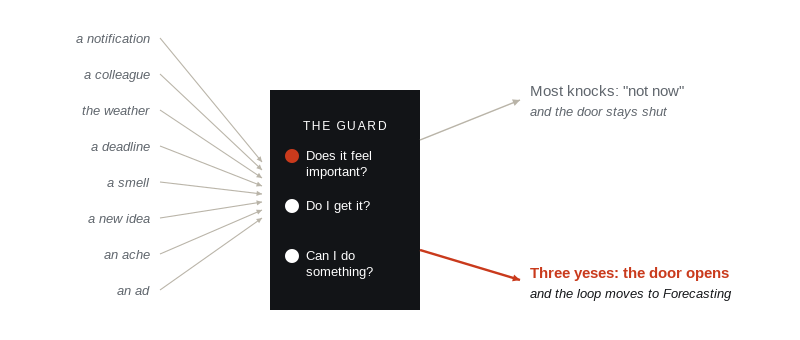
Every living thing faces the same problem: how do I know what helps me grow and what harms me? The answer, across all of life, is the senses. A fly tastes through its feet and knows, almost at once, whether to feed. A person reads a face across a room and knows whether to approach. Sensing is how organisms decide what to engage with, and Activation is the human version of that ancient filter.
The filter exists because attention is costly. Herbert Simon put it plainly half a century ago: a wealth of information creates a poverty of attention (Simon, 1971). The brain protects its scarce attention by letting very little through.
4.2 The sequence: sensing, contact, awareness
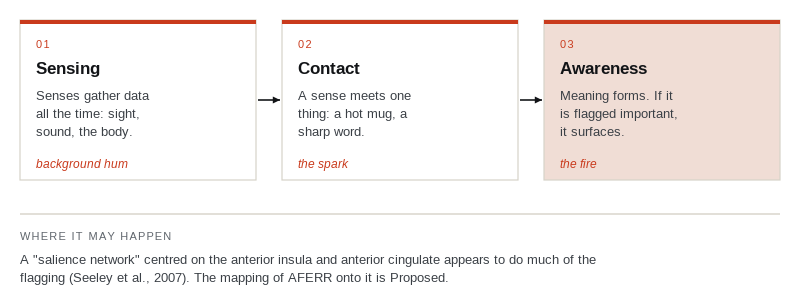
AFERR describes Activation as a short sequence.
- Sensing. Our senses are always gathering data from the world: sight, sound, touch, temperature, the state of our own body.
- Contact. When a sense meets something specific (a hot mug, a sharp word, a number on a screen), contact is made. Contact on its own carries no meaning. It is the spark, not the fire.
- Awareness. Within moments of contact, meaning begins to form. Signals are integrated and, if they are flagged as important, surface into awareness. Neuroscience has identified a salience network, centred on the anterior insula and the anterior cingulate cortex, that appears to do much of this flagging and to switch the brain between internal thought and outward attention (Seeley et al., 2007; Menon & Uddin, 2010). Evidence: the network is well studied; AFERR’s mapping onto it is Proposed.
These sequences happen constantly and at every scale. Within any one large AFERR cycle, such as learning a new job, countless micro-cycles run: a glance, a flicker of interest, a tiny guess, a small move, a slight oh. We call these micro-AFERR cycles. Each one shifts the emotional and cognitive ground for the next.
4.3 Feeling comes first
We tend to think we decide what to engage with rationally. Mostly, we feel our way in. Lisa Feldman Barrett’s work on constructed emotion, one leading account, argues that emotions are not raw reactions but predictions the brain makes from past experience, in service of action (Barrett, 2017a, 2017b). When something feels like something, the brain is saying: this matters, get ready.
High-energy feelings such as curiosity, anticipation, fear and inspiration speed Activation up. Low-energy states such as boredom, cynicism and fatigue slow it down. Curiosity is especially powerful. In one well-known study, people who were curious about the answer to a trivia question remembered it better, and also remembered unrelated faces shown while they waited, with curiosity linked to activity in the brain’s reward and memory circuits (Gruber, Gelman & Ranganath, 2014; see also Kang et al., 2009). Curiosity tends to peak when we know a little but not enough: when there is a gap of the right size between what we know and what we want to know (Loewenstein, 1994; Kidd & Hayden, 2015).
4.4 Payoff and cost
Simpler organisms activate for food, safety and reproduction. Humans activate for those, and for belonging, purpose, validation, meaning and much more. What we treat as worth our attention (in AFERR, the payoff) changes with identity, memory and experience. What once frightened us can come to fascinate us. What once seemed irrelevant can come to feel essential.
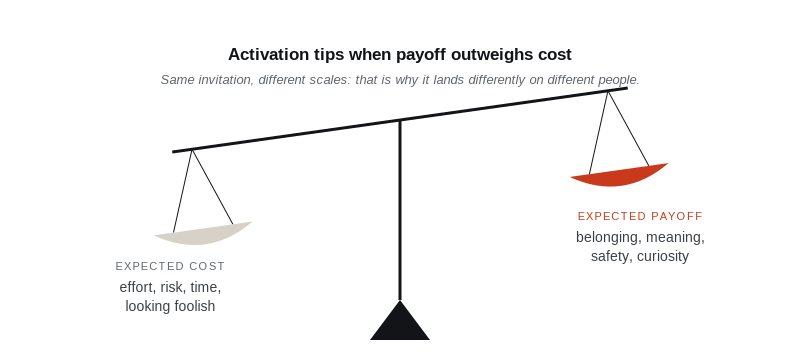
Every payoff has a cost: effort, risk, time, or emotional exposure. The brain activates when the expected payoff justifies the expected cost. This is why the same invitation lands so differently on different people. It is not that one cares and the other doesn’t. They are running different payoff-and-cost calculations.
4.5 The two gatekeepers
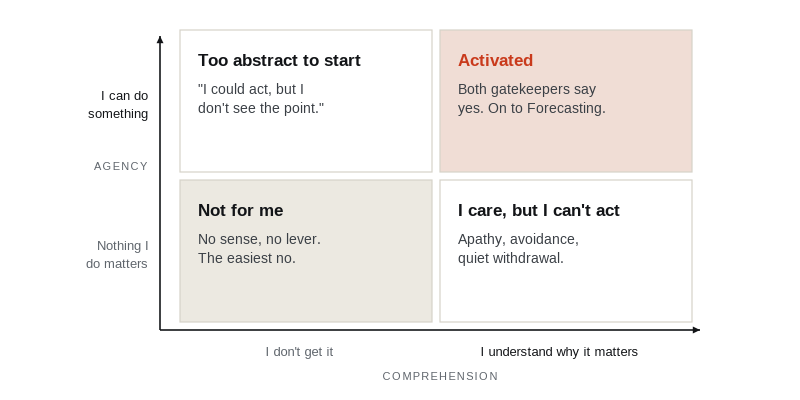
To move from Activation into Forecasting, two gatekeepers must say yes.
Comprehension: “Do I understand what this is, and why it matters?” If something is too abstract, too unfamiliar or too far from what we already know, the cost of understanding it rises. Unless the payoff looks extraordinary, the brain declines. Comprehension weighs three things together: the emotion we expect it to bring, the payoff we expect from it, and the cost we expect to pay. (Outlook: from objective, mapping it accurately, to subjective, filtering it through our own story.)
Perceived agency: “Can I do anything about this?” Even when we understand something, we disengage if we believe our actions won’t change it. The result is apathy, avoidance and quiet withdrawal. This is the citizen who cares about politics but stops voting, the employee who sees the problem but stops raising it. Research on self-efficacy shows that our beliefs about what we can do shape what we attempt (Bandura, 1977). Work on learned helplessness, revisited by its own authors fifty years on, suggests from animal studies that passivity is the default response to prolonged uncontrollable stress, and that detecting control is what has to be learned (Maier & Seligman, 2016). (Locus: from concern, I care but can’t act, to influence, I care and can act.)
4.6 Consideration span, not attention span
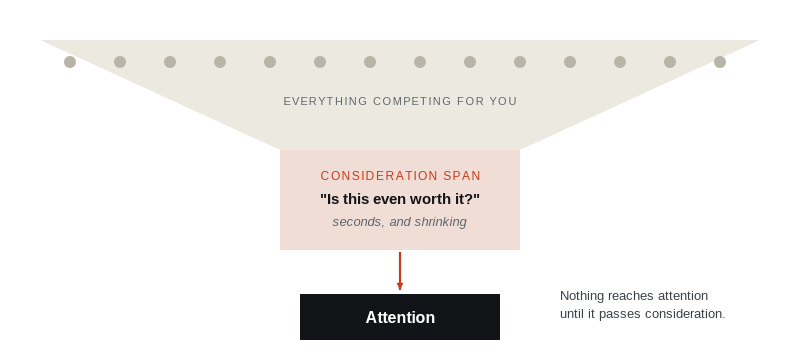
It is often said that attention spans are shrinking. AFERR proposes a more precise framing: what is shrinking is our consideration span, the time we are willing to spend deciding whether something deserves our attention at all. In a feed of endless options, the brain grows conservative and quick to dismiss. Nothing enters attention until it passes consideration. (Evidence: Proposed. This is an AFERR construct, not yet measured independently.)
The real problem is rarely that people cannot focus. It is that they do not believe the thing in front of them is worth focusing on.
4.7 Mental models and Alternate Intelligence
Each of us meets the world through a mental model: a coded framework of beliefs, predictions and memories that decides what counts as real, important or irrelevant. No two are the same. Show a wilting plant to a gardener and to a decorator. One reaches for water. The other reaches for the bin. Same stimulus, different activation.
AFERR calls the respect for this difference Alternate Intelligence: the recognition that another person’s reading of reality may be as valid as ours. For anyone designing learning, it means one activation will not work for everyone. Design several ways in.
05 · KeepKeep
5.1 What Activation changes downstream
Activation sets the quality of everything that follows. When it is strong, forecasts are richer, experiments are braver, realizations go deeper and reflection is more honest. When it is weak, the rest of the loop runs on fumes. (Observed in facilitated simulations; not yet tested.)
In teams, shared Activation shows up as trust, real dialogue and shared ownership. In organisations it becomes culture: the invisible force behind what people care about and show up for.
When Activation is weak, people don’t care. When Activation is strong, people carry.
5.2 For people who design learning
- Open with a story, a dilemma or a real stake, not an agenda. Story lowers resistance and invites identity.
- Create a gap of the right size. Enough surprise or tension to make people curious, not so much that they freeze.
- Show relevance early. Map the content to the learner’s current role, problem or goal in the first minutes.
- Hand over agency. Let learners make a choice that visibly changes something. Agency is what turns interest into engagement.
- Build trust in the container. People activate when they believe the space is safe and the facilitator is credible.
5.3 For leaders
When a team “doesn’t care”, diagnose before you motivate. Do they understand the payoff in their own terms? Do they believe their actions will change the outcome? A clearer picture fixes the first. Real decision rights fix the second. Speeches fix neither.
5.4 How Activation can be observed
In facilitated simulations, AFERR practitioners look for six signals. They are offered here as observation prompts, not a validated instrument.
| Signal | What to look for |
|---|---|
| Comprehension | Can the person map the situation to something they know, and say why it matters? |
| Perceived agency | Do they initiate (propose, question, lead) or wait to be told? |
| Range of emotion | Can they name what they feel with nuance, or only “fine” and “annoyed”? |
| Arousal | Energy at entry: quick, loud, restless, or slow, quiet, withdrawn. |
| Timing | How long from the briefing to their first meaningful action? |
| Stability | Does engagement hold across rounds, or spike and fade? |
5.5 Activation as a daily practice
With reflection, Activation can move upstream: from something triggered by whatever crosses our path, to something we choose, guided by our values and our curiosity. Over time you begin to see what you automatically say yes to, what you resist out of habit, and where your values actually sit.
5.6 Limits and open questions
- The sequence of sensing, contact and awareness is a useful description. It is not a claim that the brain processes in three clean stages.
- Consideration span is proposed, not yet measured. A first study would compare the time people take to qualify content in high-choice and low-choice settings.
- The two gatekeepers are drawn from long-standing research on comprehension, curiosity and self-efficacy. Whether they fully account for engagement, and how they interact, is an open question.
5.7 What comes next
Once something matters, the brain cannot help imagining what might happen. That is the next move: Forecasting, the subject of Phase Paper 02.
In a world of overstimulation, it isn’t attention we are losing. It is discernment. The real question is not “can you focus?” It is “do you know what is worth focusing on?”