03 / 05 · Try
Experimentation
“What if I try it?”
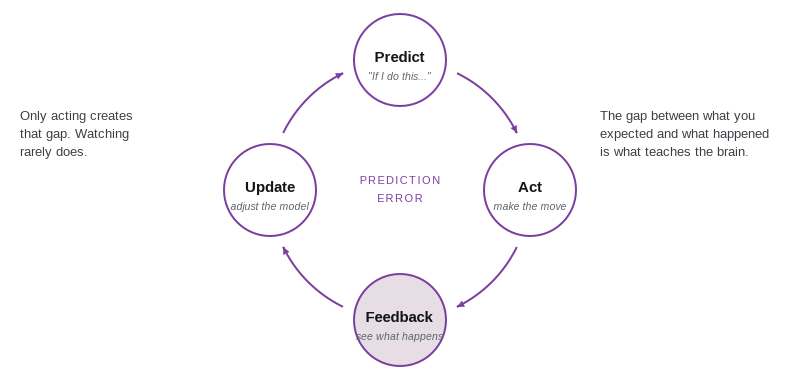
You act, and find out whether your prediction was right. The difference between what you expected and what happened is what you learn from.
At a glance
- 01The brain learns most from surprise: the gap between what you expected and what happened.
- 02Acting creates the sharpest gap, because the outcome is yours.
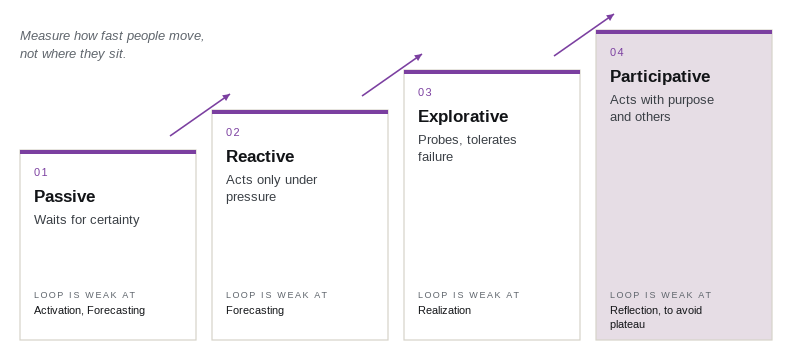
- 03People meet uncertainty in four dispositions: passive, reactive, explorative and participative. These are states, not types.
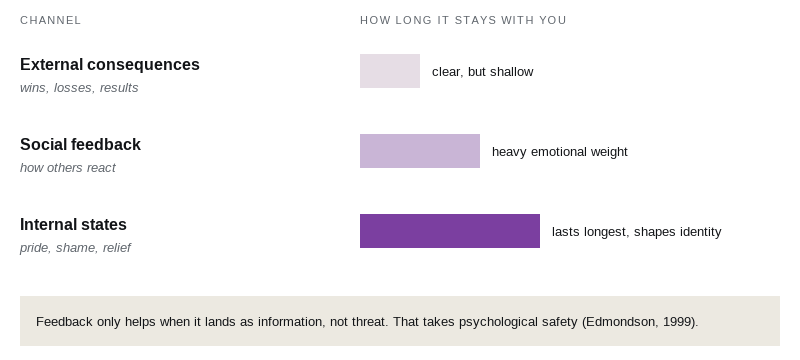
- 04Every experiment answers back through three channels: results, other people and your own feelings.
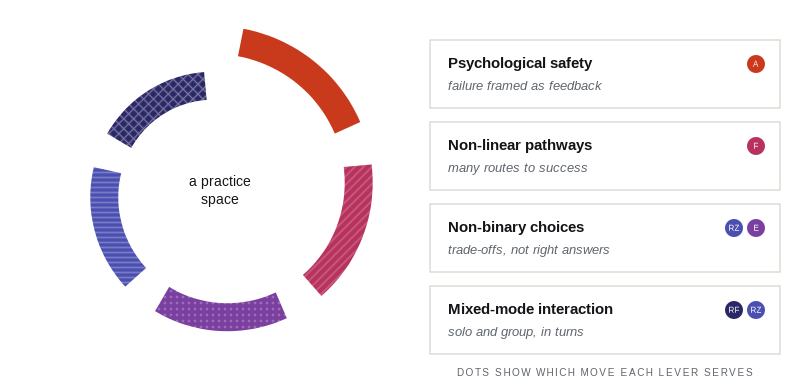
- 05If the real world is too risky to try things in, build a practice space where it isn’t.
Words to know
Try this today
Change one small habit once today. Before you do, write down what you expect. Afterwards, compare.
An everyday example
You suspect your teenager goes quiet at dinner because you ask too many questions. You could keep guessing, or you could find out. So tonight you try something small. You put your phone away, ask nothing, and talk about your own odd day instead. It feels strange. For a while, nobody says much. Then, while clearing the plates, your teenager mentions a friend you haven’t heard about in weeks. One evening proves nothing, but it has taught you more than all that wondering did. Trying something to see whether your guess was right, in a way small enough that being wrong costs little, is Experimentation.

Photos are intentionally blurred to protect the people in them.
Experimentation in 4 figures
Sources
- Bandura, A. (1977). Self-efficacy: Toward a unifying theory of behavioral change. Psychological Review, 84(2), 191-215. https://doi.org/10.1037/0033-295X.84.2.191
- Clark, A. (2013). Whatever next? Predictive brains, situated agents, and the future of cognitive science. Behavioral and Brain Sciences, 36(3), 181-204.
- Edmondson, A. C. (1999). Psychological safety and learning behavior in work teams. Administrative Science Quarterly, 44(2), 350-383. https://doi.org/10.2307/2666999
- Ericsson, K. A., Krampe, R. T., & Tesch-Römer, C. (1993). The role of deliberate practice in the acquisition of expert performance. Psychological Review, 100(3), 363-406. https://doi.org/10.1037/0033-295X.100.3.363
- Freeman, S., Eddy, S. L., McDonough, M., Smith, M. K., Okoroafor, N., Jordt, H., & Wenderoth, M. P. (2014). Active learning increases student performance in science, engineering, and mathematics. Proceedings of the National Academy of Sciences, 111(23), 8410-8415.
- Friston, K. (2010). The free-energy principle: A unified brain theory? Nature Reviews Neuroscience, 11(2), 127-138. https://doi.org/10.1038/nrn2787
- Hebb, D. O. (1949). The organization of behavior: A neuropsychological theory. Wiley.
- Kapur, M. (2008). Productive failure. Cognition and Instruction, 26(3), 379-424. https://doi.org/10.1080/07370000802212669
- Kolb, D. A. (1984). Experiential learning: Experience as the source of learning and development. Prentice Hall.
- McGaugh, J. L. (2004). The amygdala modulates the consolidation of memories of emotionally arousing experiences. Annual Review of Neuroscience, 27, 1-28. https://doi.org/10.1146/annurev.neuro.27.070203.144157
- Schultz, W., Dayan, P., & Montague, P. R. (1997). A neural substrate of prediction and reward. Science, 275(5306), 1593-1599. https://doi.org/10.1126/science.275.5306.1593
AFERRism · Monthly
Learn how you learn.
One email a month about how people learn from experience. Each issue has one piece of research, one move in practice, and one question to think about.
The AFERR course · 10 lessons