04 / 05 · See
Realization
“So that is what happened.”
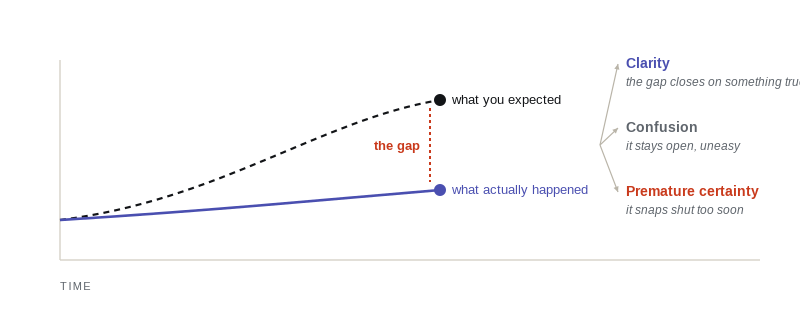
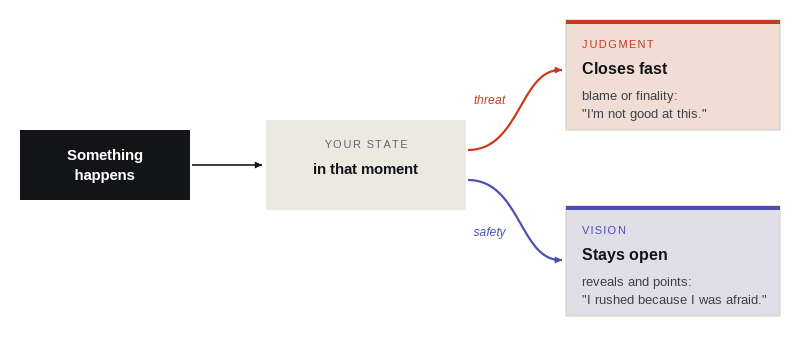
You work out why things turned out the way they did. When you feel threatened, you tend to blame someone. When you feel safe, you tend to see what to do differently.
At a glance
- 01Realization is the moment the gap between forecast and outcome closes: the ‘aha’.
- 02It can close with clarity, with confusion, or too soon with false certainty.
- 03Realizations formed under threat tend toward judgment. Those formed in safety tend toward vision.
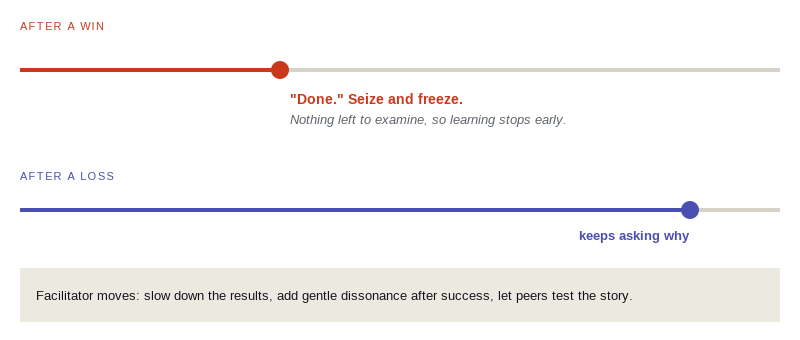
- 04Winning often stops learning. When you feel done, there seems to be nothing to examine.
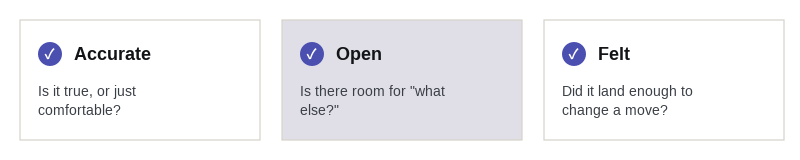
- 05A good realization is accurate, open and felt.
Words to know
Try this today
Take one recent win. Write three different reasons it went well. Which one did you believe first?
An everyday example
You were sure the new route to work would save time, and for days you told everyone so. This morning you glance at the clock as you park and see that you’re arriving exactly when you always did. Your first thought is that the traffic was unusual. Your second is that you chose badly and should have known. Then you stop and look at what actually happened. The road is quicker, but you now leave home later because you trust it. Neither the excuse nor the blame was true. The plain explanation is. Working out why things turned out the way they did, before deciding what it says about you, is Realization.

Photos are intentionally blurred to protect the people in them.
Realization in 4 figures
Sources
- Danek, A. H., & Wiley, J. (2017). What about false insights? Deconstructing the Aha! experience along its multiple dimensions for correct and incorrect solutions separately. Frontiers in Psychology, 7, 2077. https://doi.org/10.3389/fpsyg.2016.02077
- Easterbrook, J. A. (1959). The effect of emotion on cue utilization and the organization of behavior. Psychological Review, 66(3), 183-201. https://doi.org/10.1037/h0047707
- Ellis, S., & Davidi, I. (2005). After-event reviews: Drawing lessons from successful and failed experience. Journal of Applied Psychology, 90(5), 857-871. https://doi.org/10.1037/0021-9010.90.5.857
- Hattie, J., & Timperley, H. (2007). The power of feedback. Review of Educational Research, 77(1), 81-112. https://doi.org/10.3102/003465430298487
- Jung-Beeman, M., Bowden, E. M., Haberman, J., Frymiare, J. L., Arambel-Liu, S., Greenblatt, R., Reber, P. J., & Kounios, J. (2004). Neural activity when people solve verbal problems with insight. PLoS Biology, 2(4), e97. https://doi.org/10.1371/journal.pbio.0020097
- Kluger, A. N., & DeNisi, A. (1996). The effects of feedback interventions on performance: A historical review, a meta-analysis, and a preliminary feedback intervention theory. Psychological Bulletin, 119(2), 254-284. https://doi.org/10.1037/0033-2909.119.2.254
- Kounios, J., & Beeman, M. (2014). The cognitive neuroscience of insight. Annual Review of Psychology, 65, 71-93.
- Kruglanski, A. W., & Webster, D. M. (1996). Motivated closing of the mind: “Seizing” and “freezing”. Psychological Review, 103(2), 263-283. https://doi.org/10.1037/0033-295X.103.2.263
- Laukkonen, R. E., Kaveladze, B. T., Tangen, J. M., & Schooler, J. W. (2020). The dark side of Eureka: Artificially induced Aha moments make facts feel true. Cognition, 196, 104122. https://doi.org/10.1016/j.cognition.2019.104122
- McGaugh, J. L. (2004). The amygdala modulates the consolidation of memories of emotionally arousing experiences. Annual Review of Neuroscience, 27, 1-28. https://doi.org/10.1146/annurev.neuro.27.070203.144157
- Miller, D. T., & Ross, M. (1975). Self-serving biases in the attribution of causality: Fact or fiction? Psychological Bulletin, 82(2), 213-225. https://doi.org/10.1037/h0076486
- Ross, L. (1977). The intuitive psychologist and his shortcomings: Distortions in the attribution process. In L. Berkowitz (Ed.), Advances in experimental social psychology (Vol. 10, pp. 173-220). Academic Press. https://doi.org/10.1016/S0065-2601(08)60357-3
- Schultz, W., Dayan, P., & Montague, P. R. (1997). A neural substrate of prediction and reward. Science, 275(5306), 1593-1599. https://doi.org/10.1126/science.275.5306.1593
- Weick, K. E. (1995). Sensemaking in organizations. Sage.
AFERRism · Monthly
Learn how you learn.
One email a month about how people learn from experience. Each issue has one piece of research, one move in practice, and one question to think about.
The AFERR course · 10 lessons