05 / 05 · Keep
Reflection
“What changes next time?”
You decide what the experience means for next time. In our sessions, it’s the move people skip most often.
At a glance
- 01Reflection is where an experience becomes part of how you see the world.
- 02It uses a quieter mode of the brain that is active when we turn inward.
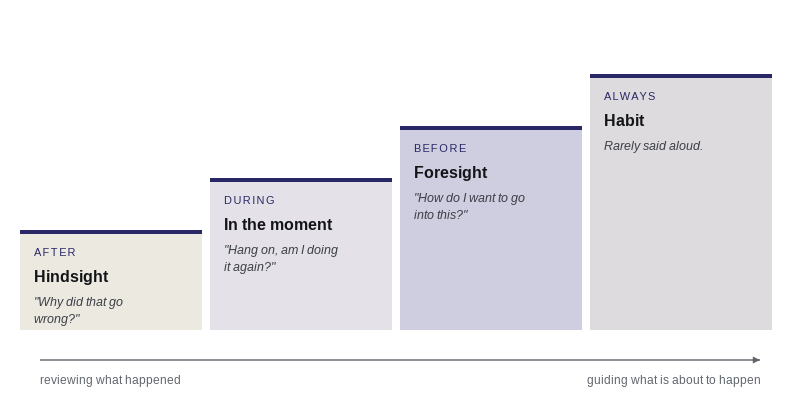
- 03It matures: from hindsight, to the moment, to foresight, to habit.
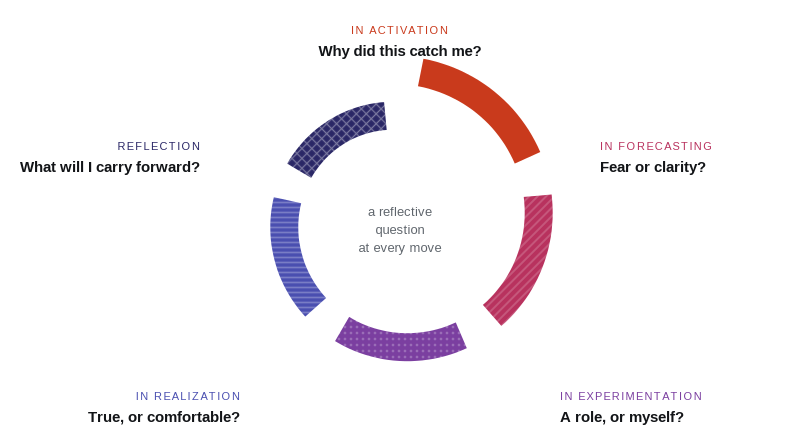
- 04It works best running through all four other moves, not only at the end.
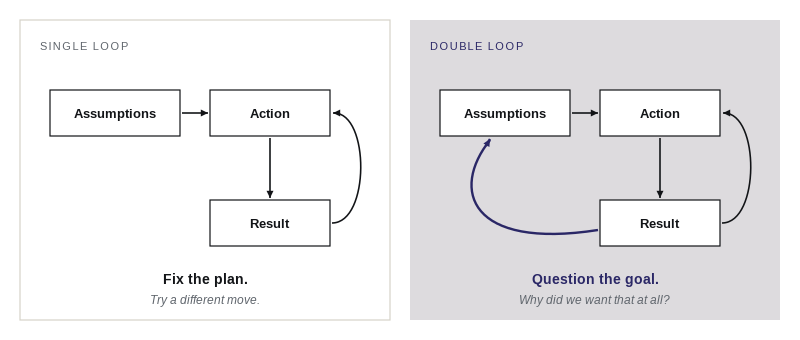
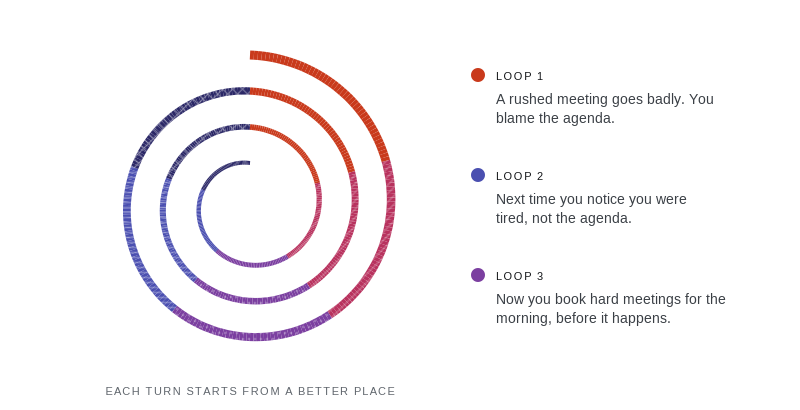
- 05Done well, it questions the goal as well as the plan, so the next loop starts from a better place.
Words to know
Try this today
At the end of today, answer one question in a sentence: what will I do differently tomorrow because of today?
An everyday example
The argument with your brother is over, and you’ve both apologised. You could leave it there, and most days you would. Instead, on the walk home, you ask yourself what you want to carry forward. Not the argument. The pattern: you get sharp when you’re tired, and you start hard conversations late at night. So you decide that next time something difficult comes up, you’ll say, “Can this wait until morning?” Nothing about today changes. What changes is how you’ll handle the next one. Deciding that on purpose is Reflection. In our sessions, it’s the move people skip most often.

Photos are intentionally blurred to protect the people in them.
Reflection in 4 figures
Sources
- Andrews-Hanna, J. R., Smallwood, J., & Spreng, R. N. (2014). The default network and self-generated thought: Component processes, dynamic control, and clinical relevance. Annals of the New York Academy of Sciences, 1316(1), 29-52.
- Argyris, C., & Schön, D. A. (1978). Organizational learning: A theory of action perspective. Addison-Wesley.
- Dewey, J. (1933). How we think: A restatement of the relation of reflective thinking to the educative process. D. C. Heath.
- Di Stefano, G., Gino, F., Pisano, G. P., & Staats, B. R. (2014). Learning by thinking: How reflection aids performance (Harvard Business School Working Paper No. 14-093). Harvard Business School. https://doi.org/10.2139/ssrn.2414478
- Diekelmann, S., & Born, J. (2010). The memory function of sleep. Nature Reviews Neuroscience, 11(2), 114-126.
- Flavell, J. H. (1979). Metacognition and cognitive monitoring: A new area of cognitive-developmental inquiry. American Psychologist, 34(10), 906-911. https://doi.org/10.1037/0003-066X.34.10.906
- Immordino-Yang, M. H., Christodoulou, J. A., & Singh, V. (2012). Rest is not idleness: Implications of the brain’s default mode for human development and education. Perspectives on Psychological Science, 7(4), 352-364.
- Kross, E., & Ayduk, O. (2017). Self-distancing: Theory, research, and current directions. Advances in Experimental Social Psychology, 55, 81-136. https://doi.org/10.1016/bs.aesp.2016.10.002
- Pennebaker, J. W. (1997). Writing about emotional experiences as a therapeutic process. Psychological Science, 8(3), 162-166.
- Raichle, M. E., MacLeod, A. M., Snyder, A. Z., Powers, W. J., Gusnard, D. A., & Shulman, G. L. (2001). A default mode of brain function. Proceedings of the National Academy of Sciences, 98(2), 676-682.
- Schön, D. A. (1983). The reflective practitioner: How professionals think in action. Basic Books.
AFERRism · Monthly
Learn how you learn.
One email a month about how people learn from experience. Each issue has one piece of research, one move in practice, and one question to think about.
The AFERR course · 10 lessons